How to Choose a Reliable Plumber: 7 Questions to Ask First
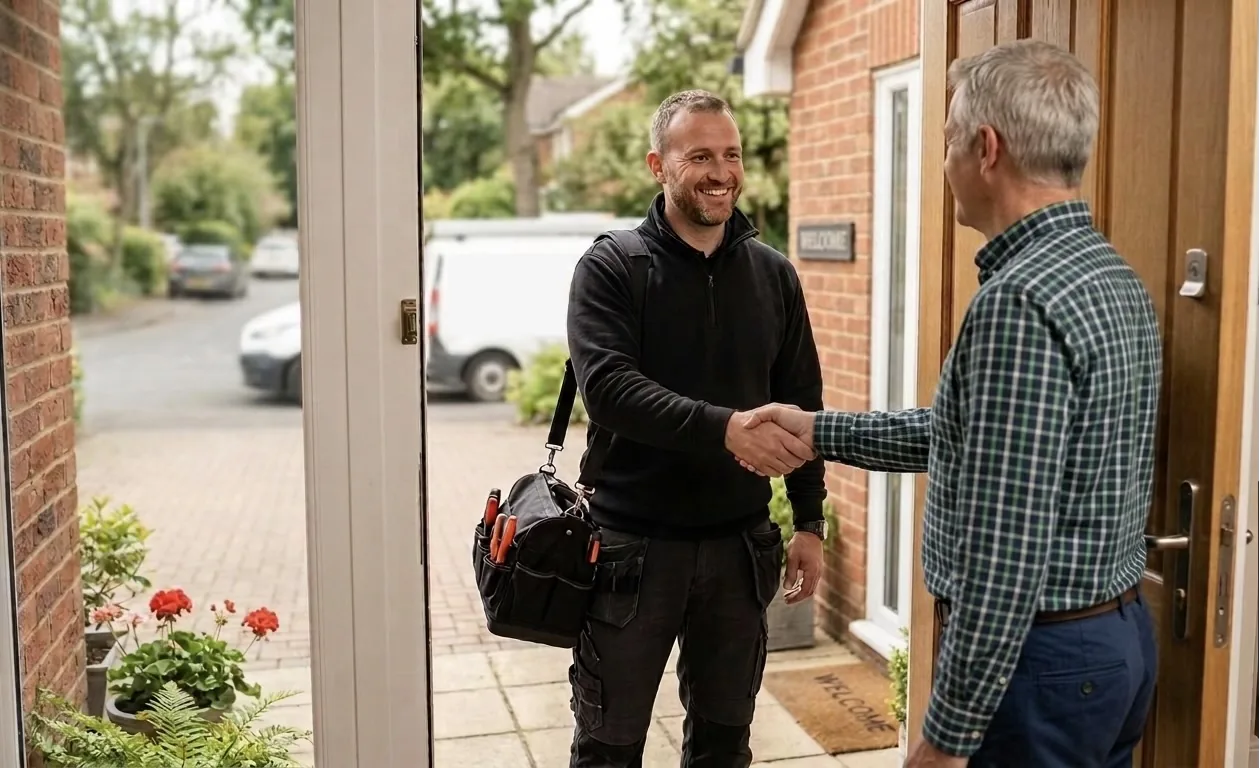
There are seven questions below, but be honest — you won’t ask all seven for a dripping tap. So here’s the short version: three of them remove most of the risk. Is the work gas (see the card), are you insured (see the certificate), and can I have the price in writing. The other four are for the jobs where real money is involved. And the reassuring part — the questions a good plumber is glad you asked are exactly the ones a cowboy hopes you won’t.
1. “Can I See Your Gas Safe Card?”
Only relevant if the job touches gas — a boiler, a gas hob, a cooker, a gas fire. But if it does, this isn’t optional politeness: anyone carrying out gas work in the UK must be on the Gas Safe Register by law.
The bit most people miss: check both sides of the card. The front has their photo, licence number and expiry date. The back lists the specific gas work they’re qualified for — and those qualifications are separate. Someone qualified on boilers isn’t automatically qualified on a gas hob or a cooker. Then take thirty seconds to check the licence number on the official Gas Safe Register site.
A genuinely registered engineer will hand you the card without blinking. They’re used to it.
2. “Are You Insured — Can I See It?”
You’re asking about public liability insurance: the cover that pays if something goes wrong and your home gets damaged in the process. Cover of £2 million or more is the norm.
Ask to see the certificate rather than accepting a yes, and check two things on it: that it’s still in date, and that the name on it matches the business actually doing your job. An expired certificate and a certificate in someone else’s name are both worth nothing to you, and both are more common than you’d hope.
This is the question people feel most awkward asking. Don’t — it’s completely routine, and the reaction to being asked tells you plenty on its own.
3. “Is That a Quote or an Estimate?”
These two words get used interchangeably in conversation, but they mean genuinely different things, and the difference is legal:
| What it means | |
|---|---|
| Quote | A firm offer. Once you accept it, it forms a binding contract at that price for the work described. |
| Estimate | An informed guess. It can move, and often does. |
Neither is dishonest. For a job where nobody can see behind the wall until they start, an estimate is the truthful answer — and a tradesperson who gives you a confident number for a job they can’t see is guessing anyway. What matters is that you know which one you’ve been given, in writing, and roughly how far an estimate might move.
Ask it like this
“Is that a quote or an estimate? And if it’s an estimate, what would make it go up?” The second half is the useful bit — it turns a vague number into a conversation about what’s actually uncertain in the job.
4. “What’s Not Included?”
Better than asking what’s included, because it flushes out the gaps. The usual suspects: VAT (is the number quoted with or without?), parts and materials, waste removal, and — the classic — making good. Lifting a floor to reach a pipe is the plumbing job; putting the floor back nicely afterwards may not be.
For bathroom work especially, ask directly who is supplying what. A price that assumes you’re buying the suite is a very different price from one that includes it. Our renovation cost breakdown goes through where the money actually goes on a bathroom.
5. “Who’s Actually Doing the Work?”
The person who comes to price the job isn’t always the person who turns up to do it. That’s not automatically a problem — plenty of good firms have several engineers, and bigger jobs bring in a tiler or an electrician. But you want to know before, not on the morning.
If parts are subcontracted, the follow-up is simple: whose insurance and whose qualifications cover that part of the job? Electrical work and gas work each need their own competent person — a first-rate plumber is not automatically either.
6. “What If Something Goes Wrong Later?”
Ask what guarantee comes with the labour, and separately what warranty comes with the parts — they’re usually different lengths, and a boiler manufacturer’s warranty often depends on it being installed by someone suitably registered and serviced annually.
Underneath any guarantee they offer, you already have a legal floor: under the Consumer Rights Act 2015, work must be carried out with reasonable care and skill. If it isn’t, you’re entitled to have it put right. A guarantee is a promise on top of that, not a replacement for it.
The practical version of this question: “If this leaks in a fortnight, what happens?” You’ll learn a lot from how readily they answer.
7. “How Do You Want Paying?”
A deposit toward materials on a big job is normal and reasonable. A large payment up front, before anything happens, is not. Nor is cash-only with no paperwork — if there’s no invoice, there’s no record, and no record means no comeback.
Where you can, pay by credit card. It’s the cheapest protection available and it costs you nothing: see the next section.
Two Rights Nobody Tells You About
These two come up rarely in the “how to hire a plumber” advice you’ll read elsewhere, and both are worth real money.
1. You usually have 14 days to change your mind
Under the Consumer Contracts Regulations, a contract agreed away from the trader’s business premises — including in your own home — normally comes with a 14-day cancellation period, and you don’t have to give a reason. The trader is supposed to tell you about it. The catch: if you ask for the work to start within those 14 days, you can lose or limit that right. So if you’re not certain, don’t press for an immediate start.
2. Paying by credit card makes your bank jointly liable
Under Section 75 of the Consumer Credit Act, where the total cost of the work is over £100 and no more than £30,000, your credit card provider is jointly liable with the trader for breach of contract or misrepresentation. Usefully, this can apply even when you only put the deposit on the card — the deposit itself can be under £100, as long as the total job is over it. Paying the deposit by card and the balance another way is often the smart move.
Red Flags
- Pressure to decide now — especially a “today only” price. Nothing about a plumbing job gets cheaper because you signed on the spot.
- Reluctance to put anything in writing.
- Cash only, no invoice.
- A large payment demanded up front.
- No fixed address, no landline, no company details — nothing that exists tomorrow.
- Vague on insurance or Gas Safe, or a card that’s “in the van” twice running.
- A price dramatically below everyone else’s. Occasionally it’s a genuinely lean operator. Usually something’s missing from it — ask question 4 again.
Scale the Questions to the Job
Worth saying plainly, because a wall of due diligence over a £90 tap swap helps nobody. For a small repair, questions 2 and 3 are plenty — insured, and a price in writing. For gas work, question 1 is non-negotiable no matter how small the job. For anything four figures — a bathroom, a boiler, a full re-pipe — ask all seven, and don’t feel awkward doing it. That’s a serious amount of money and a serious amount of disruption, and anyone worth hiring knows it.
The Short Version
Gas work? See the card, check the back, verify the number. Every job: see the insurance certificate and get the price in writing — asking whether it’s a quote or an estimate, because those mean different things in law. On bigger jobs also ask what’s excluded, who’s actually turning up, and what happens if it fails later. Pay the deposit by credit card for Section 75 cover, keep the paperwork, and remember you generally have 14 days to change your mind on something agreed at your kitchen table.