Hard Water in Bedford: Softer Than Your Neighbours, Still Hard Enough to Matter
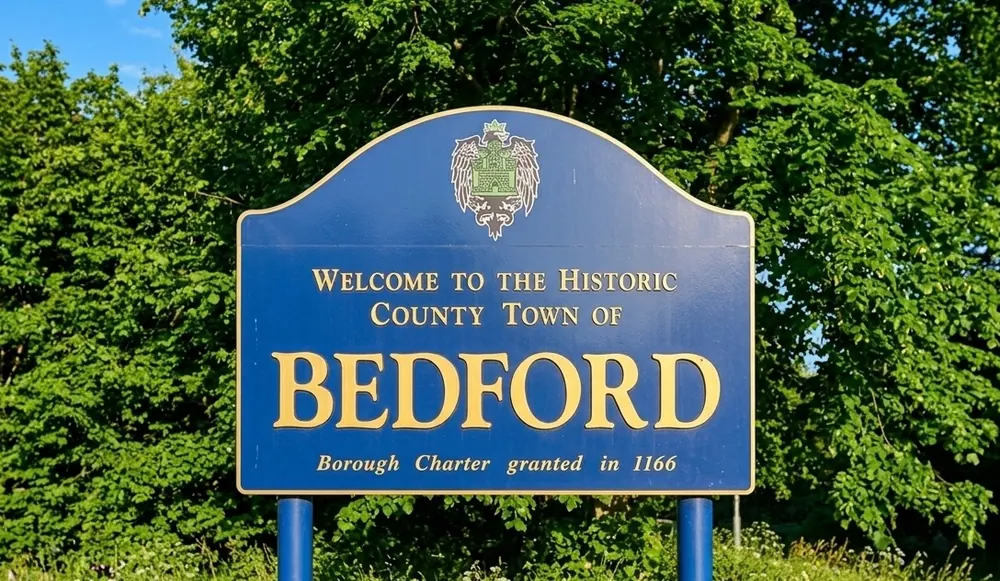
Some good news, for once: Bedford has the softest tap water of any of the main towns round here — roughly 259–261 mg/L of calcium carbonate across MK40, MK41 and MK42. That’s meaningfully below Cambridge, Huntingdon or Biggleswade. Now the caveat: it’s still classed as hard, and it’s still about 30% above the UK average. Here’s what that difference genuinely buys you, and where it changes nothing at all.
The Numbers, and How Bedford Compares
Water hardness is measured in milligrams of calcium carbonate per litre. Published postcode-level data for the Anglian Water region puts Bedford at:
- MK40 — approximately 259 mg/L
- MK41 — approximately 260 mg/L
- MK42 — approximately 261 mg/L
Consistent across the town, in other words, and all three sit in the “hard” band rather than “very hard”.
Where that sits on the scale
Soft: 0–50 mg/L. Moderately soft: 51–100. Slightly hard: 101–150. Moderately hard: 151–200. Hard: 201–300 — Bedford sits here, in the middle. Very hard: over 300. The UK average is around 198 mg/L.
Against the neighbours:
| Town | Postcode | Hardness | Band |
|---|---|---|---|
| Biggleswade | SG18 | ~336 mg/L | Very hard |
| Huntingdon | PE29 | ~309 mg/L | Very hard |
| Cambridge | CB1 | ~297 mg/L | Hard |
| St Neots | PE19 | ~276 mg/L | Hard |
| Kettering | NN15 | ~260 mg/L | Hard |
| Bedford | MK40 | ~259 mg/L | Hard |
Bedford is bottom of the table — which, in this particular table, is the good end.
What Being “Softer” Actually Buys You
Let’s be precise about the size of the win, because it’s easy to over- or under-sell.
Bedford water carries roughly 15–20% less dissolved mineral per litre than Huntingdon or Biggleswade. Scale forms broadly in proportion to that, so over the life of a boiler it’s a real difference — a Bedford heat exchanger accumulates scale more slowly than one twenty miles up the A421, all else being equal.
What it does not mean is that you’re in a soft-water area. At 259 mg/L you are still comfortably past the threshold at which water actively deposits scale rather than staying in solution. Your kettle will still fur up. Your shower head will still block. Your boiler will still scale — just a bit more slowly. Anyone who has moved here from Yorkshire or the West Country will not be fooled for a second.
The honest summary: Bedford buys you time, not immunity.
What It Still Does to Your Boiler
A combi heats hot water on demand through a plate heat exchanger — thin metal plates, cold mains one side, hot heating water the other. It works because the plates are clean, and hard water is in the business of making them not clean. Calcium carbonate deposits on the hot metal and forms an insulating crust, so the boiler burns longer and hotter for the same hot tap.
Widely cited industry figures give a sense of the cost:
- Carbon Trust — 1mm of scale increases the energy needed by around 7% for the same heat output.
- British Water — roughly 12% efficiency loss at 1.6mm of scale, rising to about 25% at 3mm.
Treat those as indicative — the real rate depends on your water temperature, how much hot water you use, and the boiler’s design. In Bedford you’ll get there more slowly than in Huntingdon. You will still get there.
The free fix almost nobody does
Calcium comes out of solution faster as water gets hotter, and the rate climbs steeply above about 60°C. If your combi’s hot water is set to maximum, turn it down to roughly 55–60°C. It costs nothing, slows scaling, and usually trims the gas bill a little. Exception: a stored hot water cylinder needs to reach 60°C to control legionella — don’t turn that one down.
Queens Park to Great Denham
Bedford’s housing stock is unusually varied, and the age of your pipework changes how hard water shows up.
Victorian terraces and villas — Queens Park, Castle Road, De Parys. Long pipe runs, repeatedly altered, and often a combi retro-fitted into a property never designed for one. Decades of internal scale narrows the effective bore of old pipework, and the symptom is usually poor flow at the furthest or highest tap rather than an obvious leak or fault.
Post-war and 1960s–70s housing — Putnoe, Brickhill, much of Kempston. Copper pipework at or beyond its design life, very often on a heating system that has never been flushed. Scale plus accumulated magnetic sludge is the standard cause of radiators that are hot at the top and cold at the bottom, and of a pump that sounds like it’s working harder than it should.
Newer estates — Great Denham, Wixams, Shortstown. Plastic pipework doesn’t scale internally like old copper, so people assume they’re fine. The pipes may well be. The boiler, the shower cartridge, the dishwasher and the kettle all see the same 259 mg/L water as everyone else — and those are the parts that cost money to replace.
Signs It’s Doing Damage
- Banging or kettling from the boiler when it fires — hot spots under scale. The one on this list not to ignore.
- Hot water slower to arrive at the kitchen tap than it used to be.
- Radiators hot at the top, cold at the bottom. Sludge, not air — bleeding won’t fix it.
- Stiff or dripping mixer taps. Calcium in the ceramic disc cartridge, not a worn-out tap.
- Shower flow dropping off — usually a scaled head or cartridge.
- Gas bill drifting up with no change in habits.
What’s Worth Doing Here
Because Bedford sits at the friendlier end of the scale, the cheap measures go further here than they do in the harder towns — which changes the value ranking a bit.
- Heating inhibitor, correctly dosed. Cheapest useful protection there is, and the most commonly neglected — it gets depleted every time the system is drained for a repair or a radiator swap and rarely gets topped back up. At Bedford’s hardness this genuinely does a lot of the work.
- Magnetic filter. Catches circulating debris before it reaches the boiler. Cheap fitted alongside a boiler replacement, dearer as a standalone visit. Most manufacturers expect one.
- Descale the visible things on a schedule. Kettle, shower head, tap aerators. Dull, effective.
- Under-sink filter. Nicer tea, longer-lived kettle. Does nothing for the boiler or shower.
- Whole-house softener. Still the comprehensive answer, and still works — just with a longer payback period here than in Huntingdon or Biggleswade.
Softener or Not?
Bedford is the one town locally where this is a genuinely close call, so here’s the honest split.
Worth it if you own the house, you’re staying a good five to ten years, and you either hate the cleaning or want to give an expensive boiler the easiest possible life. It’s also an easy yes if you’re already having plumbing work done — a bathroom refit or a boiler swap is when adding one is cheapest, because the pipework is already open and accessible.
Less so if you’re renting, likely to move within a few years, or weighing the spend against other jobs in the house. At 259 mg/L, inhibitor plus a magnetic filter plus a lower hot-water setting plus an annual service gets you a good proportion of the benefit for a small fraction of the cost. In Biggleswade I’d push harder on the softener. In Bedford, the cheap stack is a perfectly respectable answer.
Non-negotiable either way: an annual boiler service by a Gas Safe registered engineer. Tell them you want the scale situation checked, not just the combustion. It’s a warranty condition too — manufacturers generally require an annual service recorded in the Benchmark logbook, and a missed one can be enough for them to decline a claim later.
The one-line version
Bedford’s water buys your boiler time, not immunity — so spend on the cheap protection first and decide on a softener second.
The Short Version
Bedford tap water runs at roughly 259–261 mg/L calcium carbonate — the lowest of the local towns, comfortably in the “hard” band, and still about 30% above the UK average. You’ll scale more slowly than Huntingdon or Biggleswade, but you will scale. Dose the inhibitor, fit a magnetic filter, turn the combi’s hot water down a notch, descale the visible things, and get the boiler serviced every year. A softener is a reasonable buy for long-term owners and an easy one if you’re already having work done. Tell us what you need and we’ll connect you with a vetted local plumber who can quote on it.
Sources
- Postcode-level hardness figures for MK40–42 and comparison towns — WaterHard.uk, Anglian Water hardness by postcode
- Regional hardness and chalk aquifer explanation — Anglian Water, “Hard water in our region” and its hard water fact sheet (PDF)
- Boiler efficiency loss from scale (Carbon Trust and British Water figures, as widely cited in the heating industry) — The price of hard water: limescale and energy consumption
- Annual servicing as a manufacturer warranty condition — Vaillant domestic boiler guarantee terms
Hardness varies by supply zone and can change over time. For a reading specific to your address, use your water company’s postcode lookup. Figures above were checked in July 2026.