Electric vs Mixer Shower: Which Is Better?
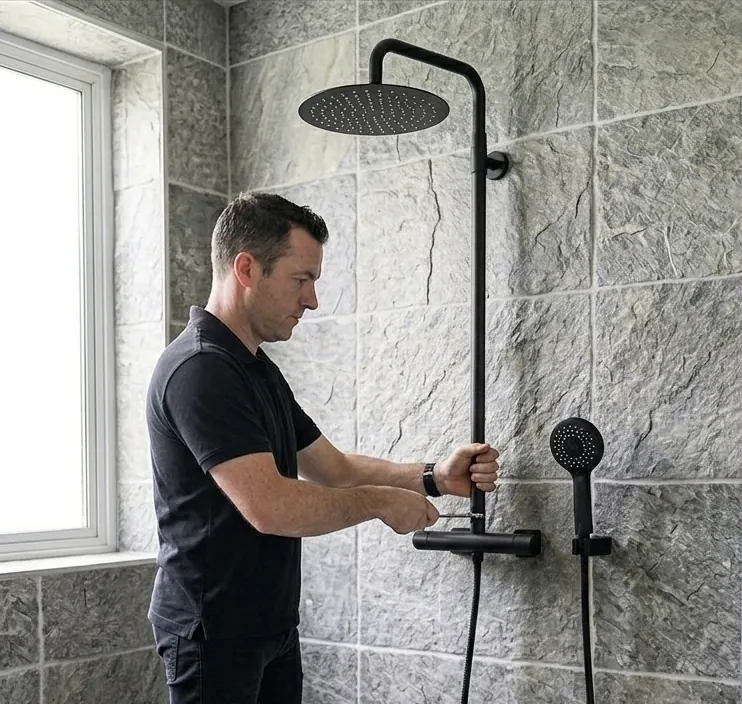
Here’s the straight answer: if you’ve got a decent boiler and good mains flow, a mixer shower gives you a noticeably better shower — more water, more pressure. Choose electric when you want hot water that doesn’t depend on the boiler, or when the budget or the plumbing won’t stretch. Expect around £250–£600 fitted for electric and £600–£1,200 for a mixer. Below is the honest comparison — including the running-cost sum most guides get lazy about.
How Each One Actually Works
The difference is simple, and everything else follows from it. An electric shower heats the water itself. A mixer shower doesn’t heat anything at all.
An electric shower takes a cold feed only and heats it on the way through with an element, like an oversized kettle on the wall. It has its own dedicated electrical circuit, and it works whether your boiler is running or not.
A mixer shower takes a hot feed and a cold feed and blends them to temperature — a thermostatic valve holds that temperature steady when someone flushes the loo. It has no heater of its own, so it’s entirely dependent on your hot water: your combi, or your cylinder.
| Electric | Mixer | |
|---|---|---|
| Typical flow | 5 – 9 litres/min | 8 – 12 litres/min |
| Works if boiler fails | Yes | No |
| Weaker in winter | Yes, noticeably | No |
| Needs an electrician | Yes — own circuit | No |
| Fitted cost | £250 – £600 | £600 – £1,200 |
That “weaker in winter” row surprises people. An electric shower heats whatever comes in, so when the mains drops to around 5°C in January it has to slow the flow down to reach temperature. Same shower, same setting — less water. A mixer doesn’t care, because the boiler has already done the work.
What Each Costs to Fit
Typical 2026 UK prices, fitted:
| Job | Typical fitted cost |
|---|---|
| Electric shower, like-for-like swap | £250 – £350 |
| Electric shower, first-time install | £500 – £600 |
| Mixer shower installation | £600 – £1,200 |
Electric wins on price for one reason: less plumbing. It only needs a cold feed, so there’s no hot pipe to run and no cylinder to work around. The jump from £250 to £600 is the electrics — a first-time install needs a dedicated circuit, its own breaker and a pull-cord isolator, which is electrician’s work, not a plumber’s.
The mixer range is wide because it depends what’s behind the wall. A concealed valve in a tiled wall means chasing out and re-tiling; an exposed valve onto existing pipes is far simpler. If you’re replacing like-for-like, our guide to replacing an electric shower covers what’s involved, and if you’re removing a bath entirely, see bath to shower conversion.
What Each Costs Per Shower
This is where the myths live. People assume electric showers are expensive to run because electricity costs more than gas — roughly 26p per kWh against 7p under the July 2026 price cap. Nearly four times the price. So an electric shower must cost four times as much, surely?
It doesn’t. Here’s an 8-minute shower, worked through:
| 8-minute shower | Electric (9.5kW) | Mixer (gas combi) |
|---|---|---|
| Water used | ~40 litres | ~80 litres |
| Energy cost | ~33p | ~27p |
| Water (if metered) | ~17p | ~34p |
| Total, metered home | ~50p | ~61p |
Figures are illustrative, based on the July 2026 price cap (26.11p/kWh electricity, 7.33p/kWh gas) and a mid-range combined water and sewerage rate of about £4.20 per 1,000 litres. Your own water rate could be anywhere from roughly £3.40 to over £6 per 1,000 litres depending on which company you’re with, and unmetered homes pay nothing extra per shower.
The line worth remembering
An electric shower isn’t cheap because electricity is cheap. It’s cheap because it gives you less water. The lower flow is exactly why the running cost stays down — and exactly why the shower feels weaker. You are paying less because you’re getting less.
So on running cost alone, there’s no strong winner — a few pence a shower either way, and a water meter tilts it towards electric. Choose on how good the shower is and what your plumbing can support, not on a running-cost difference of 10p.
The Bit That Decides How Good It Feels
Flow rate. Not the price, not the brand, not the number of settings on the dial — litres per minute. An electric shower at 5–9 litres a minute will always feel gentler than a mixer at 8–12, and nothing about the fitting changes that.
The catch is that a mixer only delivers its 8–12 if your plumbing can supply it. Off a combi, that means your incoming mains flow — the same number that decides whether a combi or system boiler suits your house. You can measure it in two minutes: time how long a 10-litre bucket takes to fill from the cold mains tap, then divide 10 by that time in minutes. Under about 10 litres a minute, a fancy mixer will disappoint you and the shower head won’t be the reason.
One more local consideration: in a hard water area like ours, limescale is the thing that kills showers. It furs up an electric shower’s element and blocks the head; on a mixer it clogs the cartridge. Wiping the head dry and descaling it every few months genuinely extends the life of either.
Electric If… / Mixer If…
Choose electric if…
You want hot water even when the boiler is off or broken · it’s a second bathroom, en-suite or loft room a long way from the cylinder · you have a big household and the cylinder keeps running out · it’s a rental or a budget job · or there’s no practical way to run a hot feed to the shower.
Choose a mixer if…
You want the best shower and have the boiler and mains flow to feed it · you have a modern combi or a decent unvented cylinder · you want stable temperature and a proper drenching flow · or you’re doing a full bathroom anyway and the pipework is already open.
Most homes doing a proper bathroom refit should fit a thermostatic mixer. Most homes wanting a cheap, reliable, boiler-independent shower in a spare room should fit electric. It really is that clean a split.
Three Mistakes Worth Avoiding
- Buying the biggest kW electric shower you can find. A 10.8kW unit needs the cable and consumer unit capacity to match. If your existing circuit can’t carry it, that “better” shower means a rewire — always check what the current circuit is rated for before you buy.
- Fitting a mixer without checking flow first. Do the bucket test. A weak mains supply produces a weak mixer shower, and no amount of money spent on the valve fixes it.
- Assuming a pump will rescue it. You can’t pump a mains-fed combi supply, and pumps are only an option on gravity-fed cylinder systems. Ask before you plan around one.
The Short Version
Electric shower: £250–£600 fitted, ~50p a shower on a meter, works when the boiler doesn’t, weaker in winter. Mixer shower: £600–£1,200 fitted, ~60p a shower, noticeably better flow, but only as good as the hot water and mains behind it. Running costs are near enough a wash, so pick on the shower you want and the plumbing you’ve got. Measure your mains flow before spending on a mixer — that number decides more than the product does.