Combi vs System Boiler: Which Should You Choose?
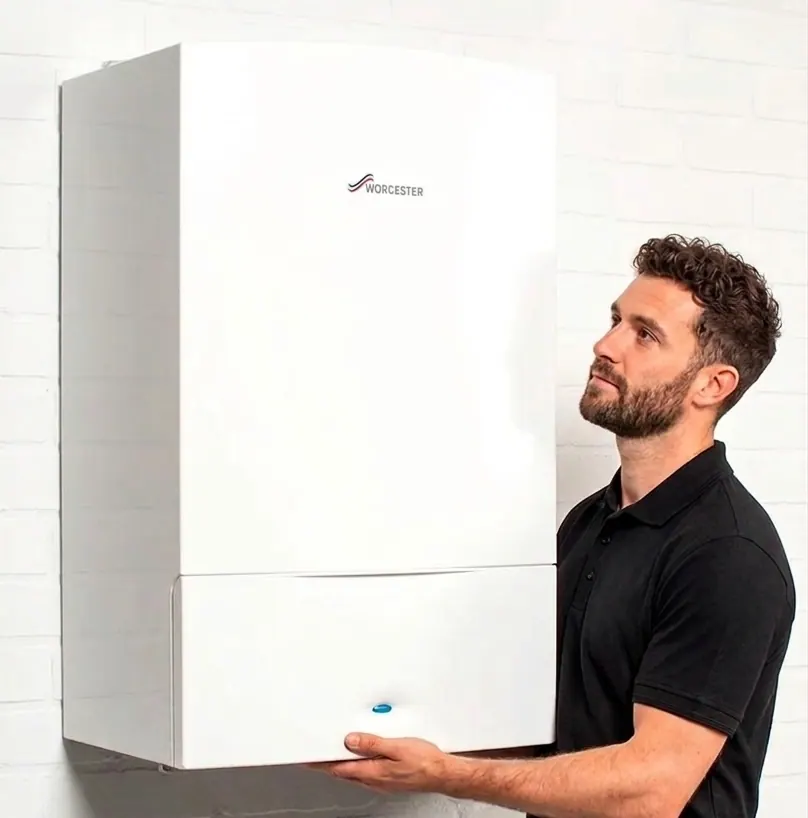
If you’re replacing a boiler and someone’s asked whether you want a combi or a system, here’s the honest answer in one line: one bathroom and up to three bedrooms — get a combi. Two or more bathrooms in daily use, or four-plus bedrooms — get a system boiler with a cylinder. That covers most homes. Below is why, what each really costs in 2026, and the one two-minute test you should do before committing either way.
The Actual Difference
Strip away the sales talk and it comes down to one thing: a combi makes hot water on demand, a system boiler stores it.
A combi takes cold water straight off the mains and heats it as it passes through, the moment you open a tap. No cylinder, no loft tanks, nothing stored. A system boiler heats a cylinder full of water — usually in the airing cupboard — and that stored tankful is what feeds your taps and showers.
Everything else follows from that:
| Combi | System | |
|---|---|---|
| Hot water cylinder | None needed | Required |
| Space taken | Just the boiler | Boiler + airing cupboard |
| Two showers at once | Struggles | Handles it |
| Can you run out? | Never — endless | Yes, if the cylinder empties |
| Depends on mains pressure | Completely | Much less |
So a combi gives you unlimited hot water but only at the rate your mains can deliver it. A system boiler gives you a fixed amount of hot water, but delivers it strongly to several outlets at once. Unlimited-but-thinner versus plentiful-but-finite — that’s the whole trade-off.
What Each Costs Installed
Combis are cheaper to fit, simply because there are fewer parts and less pipework. Typical 2026 UK prices, fully installed by a Gas Safe engineer:
| Job | Typical installed cost |
|---|---|
| Combi swapped for combi | £1,800 – £3,000 |
| System swapped for system | £2,200 – £4,000 |
| System converted to combi | £2,500 – £4,500 |
Where you land in those ranges depends on the brand, the boiler’s output, whether the flue or gas supply needs upgrading, and how far the new unit sits from the old one. Our full 2026 boiler cost guide breaks the numbers down properly, and if your current boiler is limping rather than dead, read repair or replace first — a £300 fix beats a £2,500 decision you didn’t need to make yet.
The Bucket Test (Do This Before You Decide)
Here’s the bit most people skip, and it’s the one that causes the regret. A combi is only ever as good as the mains feeding it. No combi can deliver more hot water than the pipe coming into your house can supply, no matter what the brochure says or how much you spend.
A combi needs a minimum of 10 litres per minute of incoming mains flow (the minimum under Boiler Plus). Most UK homes sit somewhere between 10 and 15 litres per minute. Fine — but if yours is at the bottom of that range, a big premium combi will not perform anything like its rated figure.
The two-minute bucket test
Take a 10-litre bucket to your cold mains tap — the kitchen tap or an outside tap fed directly off the mains. Open it fully and time how long it takes to fill. Divide 10 by that time in minutes. Thirty seconds (0.5 min) means 20 litres per minute — excellent. A full minute means 10 — the bare minimum. Longer than that, and a combi is the wrong boiler for your house.
Two things worth knowing before you take the reading as gospel. Internal pipework can throttle the flow after it enters the house — 15mm pipe restricts more than 22mm, and old lead or galvanised pipe furred up with scale restricts a lot more. And in a hard water area like ours, that furring is a real, gradual thing rather than a theoretical one. If the test comes out marginal, a good engineer will check the pipe sizing rather than just fit the boiler and hope.
Combi If… / System If…
Choose a combi if…
You’ve got one bathroom and roughly 1–3 bedrooms · your mains flow passes the bucket test · you want the airing cupboard and loft tanks gone · and hot water is rarely needed in two places at once. For the majority of UK homes, this is the answer.
Choose a system boiler if…
You’ve got two or more bathrooms in genuine daily use · four or more bedrooms or a busy household · weak mains flow · or you want to keep the option of solar hot water. The cupboard space is the price you pay for two showers running properly at the same time.
The honest test is not how big your house is — it’s how often two hot taps are open at once. A four-bed with one family bathroom and staggered mornings is happy on a combi. A three-bed where two people shower at 7am while the washing-up is running is not.
Switching From a System to a Combi
Plenty of people want the airing cupboard back, and converting is a genuinely popular job. It costs more than a straight swap — typically £2,500–£4,500 — because the cylinder and any loft tanks have to come out, the pipework has to be reworked, and the mains supply has to be up to the job. Removing the cylinder and rerouting the pipes alone commonly adds £300–£600 to the bill, and it’s usually a two-day job rather than a one-day one.
Worth doing if you have one bathroom, decent flow, and you’d rather have the storage space and the endless hot water. Not worth doing if you have two bathrooms in daily use or borderline mains flow — you’d be spending thousands to make your showers worse, and that’s a hard thing to undo. There’s also the redecorating no one mentions: pulling out a cylinder leaves a cupboard that needs boarding, plastering and painting.
One thing to watch
A combi conversion is a much bigger sale than a like-for-like swap. If you’re being steered towards one and you’ve got two bathrooms, ask the engineer directly what your measured mains flow rate is — in litres per minute. If they haven’t measured it, they’re guessing at the single most important number in the job.
Running Costs and Efficiency
Day to day there’s less between them than people expect. Both are condensing boilers running at 90%+ efficiency, and when each is correctly sized for the property, running costs are broadly similar.
The one real difference is standing heat loss: a system boiler keeps a cylinder of water hot whether you use it or not, so a small household on a combi will pay slightly less because nothing sits there cooling down. Modern cylinders are well insulated and the gap is modest — it is not a reason on its own to change boiler type. If your bills are the problem, the age and efficiency of your current boiler matters far more than which type you pick.
Sizing matters more than either. An oversized combi cycles on and off and wastes gas; an undersized one can’t keep up. Any engineer worth using will work the output out from your radiators and hot water demand rather than just matching whatever number is on the old unit.
The Short Version
One bathroom, 1–3 bedrooms, decent mains flow — combi, and expect £1,800–£3,000 installed. Two-plus bathrooms, four-plus bedrooms, or a household where hot taps run at the same time — system boiler, at £2,200–£4,000. Converting a system to a combi runs £2,500–£4,500 and is worth it only if the bathroom count and the flow rate are on your side. And whatever you’re quoted, do the bucket test first — a combi can never give you more hot water than your mains delivers.