One Radiator Not Working? How to Fix It
Every other radiator in the house is hot. The boiler's on, the pump's running, the thermostat is calling for heat. But one radiator is stone cold. This is one of the most common heating complaints we get, and it's almost always one of three things — all of which you can check yourself before calling anyone out.
Quick Diagnosis: Where to Feel First
Before you start taking anything apart, feel the two pipes going into the radiator — one at each end, usually at the bottom. Don't bother feeling the radiator body itself yet. The pipes tell you whether hot water is even reaching the radiator.
What the pipes tell you
- Both pipes cold — no hot water is getting to the radiator at all. The problem is a closed valve (lock shield or TRV) or a blockage in the pipework.
- One pipe hot, one pipe cold — water is reaching the radiator but not flowing through it. Usually air trapped inside, or the return valve is shut.
- Both pipes warm, radiator hot at the bottom but cold at the top — classic air lock. Water is circulating but air is sitting at the top of the radiator, blocking the heat.
Now you know what you're dealing with, work through these three checks in order.
Check 1: The Lock Shield Valve
The lock shield is the valve at the opposite end of the radiator to the TRV (the one with the temperature dial). It's usually covered by a white or chrome plastic cap with no markings on it. Most people don't even know it's there.
The lock shield controls the flow rate through the radiator. When a heating system is balanced, each lock shield is set to a specific position to ensure all radiators heat evenly. But sometimes they get knocked shut accidentally — by a vacuum cleaner, by a child, by someone who didn't know what it was and turned it.
How to check and open it
- Pull or unscrew the plastic cap off the lock shield.
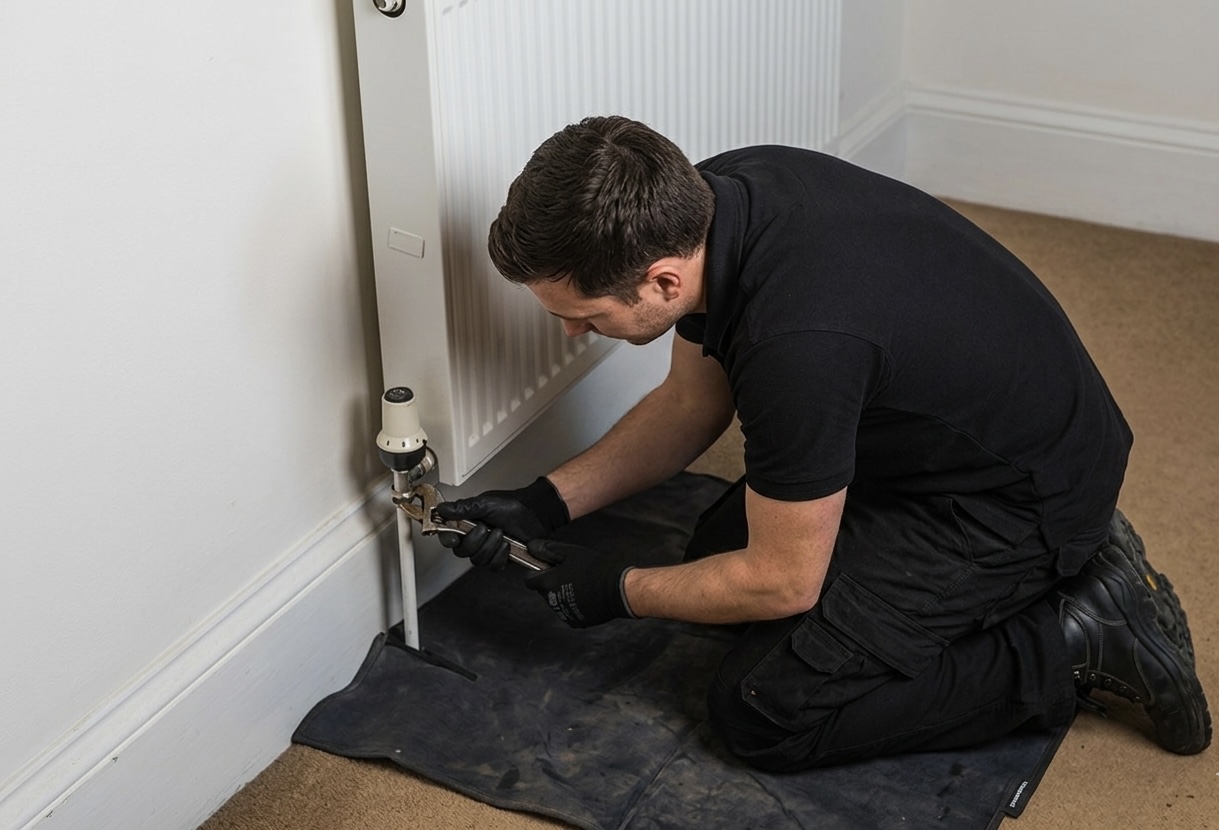
- Underneath you'll find a spindle with a flat or square head. Get an adjustable spanner on it.
- Turn it anti-clockwise as far as it'll go. This opens the valve fully.
- Now feel the pipes. If one starts getting warm within a minute or two, you've found the problem.
Don't forget to re-balance later
Opening the lock shield fully will get the radiator working, but it might mean other radiators in the house don't get as hot. That's because you've changed the balance of the system. For now, getting heat into the cold room is the priority. If you notice other rooms cooling down slightly, the system needs re-balancing — that's a separate job involving a thermometer and patience.
Check 2: Bleed the Radiator
If the lock shield is already open and you've got hot pipes reaching the radiator, but the radiator itself is hot at the bottom and cold at the top, there's air trapped inside. The air rises to the top and sits there, blocking the hot water from filling the full height of the radiator.
How to bleed it
- Turn the boiler and pump off first. This is important. If you bleed a radiator with the pump running, you can draw more air into the system. Turn everything off and wait a couple of minutes for the pressure to settle.
- Find the bleed valve. It's a small square-headed valve at the top corner of the radiator, usually at the opposite end to the pipework.
- Hold a cloth or small container underneath to catch the water.
- Insert a radiator key and turn it slowly anti-clockwise. You don't need much — a quarter-turn is enough.
- You'll hear a hiss as the air escapes. Keep the valve open until the hissing stops and water starts to dribble out. It might spit and splutter first — that's air and water mixed together. Wait for a steady trickle of water with no air.
- Tighten the valve back up. Don't overtighten — just snug.
- Turn the boiler and pump back on. Feel the top of the radiator — it should start warming up within a few minutes.
Check your boiler pressure afterwards
Bleeding radiators releases water from the system, which drops the pressure. Check the pressure gauge on your boiler — it should read between 1 and 1.5 bar when the system is cold. If it's dropped below 1 bar, you'll need to top it up using the filling loop (the braided hose underneath the boiler with a valve on it). Open it slowly until the gauge reads 1.2–1.5 bar, then close it. If you're not sure where the filling loop is, check the boiler manual or give us a call.
Check 3: Stuck TRV Pin
The TRV (thermostatic radiator valve) is the valve with the numbered temperature dial — usually at the flow end of the radiator. Inside the TRV body, there's a small pin that moves up and down to control the flow of water. When the room is cold, the pin should be pushed up (open) by the return spring. When the room reaches temperature, the TRV head pushes the pin down (closed).
The problem: these pins seize. Especially on radiators that have been turned off for the summer, or in rooms that don't get used often. The pin gets stuck in the closed position and no amount of turning the dial makes any difference — the valve is physically jammed shut.
How to free a stuck TRV pin
- Make sure the TRV dial is turned to its highest setting (usually 5).
- Remove the TRV head. The method depends on the manufacturer:
- Screw collar type — unscrew the ring at the base of the head and lift it off.
- Danfoss clip type — pop the plastic clip out with a small flat screwdriver, give the head a quarter-turn, and lift off.
- Push-fit type — just pull it straight off.
- With the head removed, you'll see the pin. If it's stuck down (flush with or below the valve body), it's seized.
- For traditional pin-type TRVs: grip the pin gently with a pair of long-nosed pliers and wiggle it upwards. Don't yank it — ease it out. You're trying to break the corrosion or scale that's holding it. Once it moves, push it back down and let it spring up a few times to free it.
- For wider piston-type TRVs: place the handle of a screwdriver or a piece of wood on top of the pin and give it a light tap with a hammer. Not a whack — a tap. You're trying to shock the corrosion loose, not drive the pin through the valve. One or two taps should do it.
Don't hit a traditional pin-type TRV with a hammer
This is the mistake we see most often. On a traditional TRV with a thin pin, a hammer strike can knock the pin clean out of the valve body. Once it's out, you've got an open pipe with pressurised hot water spraying everywhere. If the pin won't free with gentle plier work, stop — the valve needs replacing, not forcing.
Once the pin is moving freely, push it down and watch it spring back up. If it stays down or moves sluggishly, the TRV is on its way out and will likely stick again. At that point, it's worth replacing the valve rather than freeing it every few months.
Refit the TRV head, turn the dial to your preferred temperature, and check that the radiator starts heating up. Give it five to ten minutes — TRVs don't respond instantly.
Still Cold? What Else It Could Be
If you've opened the lock shield, bled the radiator, and freed the TRV pin, and the radiator still won't heat up, the problem is deeper:
- Sludge blockage. Over time, rust and magnetite (black sludge) builds up inside radiators and pipework. It settles at the bottom of radiators and can block the flow completely. The fix is a power flush — a machine that forces water and cleaning chemicals through the system at high pressure to clear the debris. Not a DIY job.
- The radiator needs removing and flushing. Sometimes the sludge is concentrated in one radiator. Taking it off the wall and flushing it with a hose in the garden can clear it. You'll need to isolate both valves, drain the radiator, disconnect it, and reconnect it afterwards — doable if you're confident with compression fittings, but messy.
- The system isn't balanced. If multiple radiators on the same circuit are underperforming, the system probably needs balancing. This involves adjusting every lock shield in the house so that water flow is distributed evenly. It's tedious but effective.
- Pump or diverter valve issue. If the pump is weak or a motorised valve isn't opening fully, some radiators won't get enough flow. This is a job for a heating engineer.
For a single cold radiator, the three checks above fix it the vast majority of the time. If you've worked through all of them and it's still cold, it's worth getting someone out to diagnose it properly rather than guessing.