How to Drain a Central Heating System
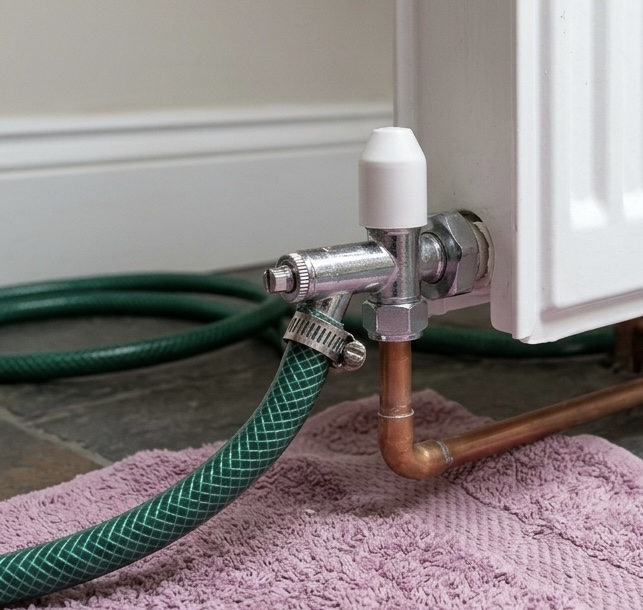
Whether you're replacing a radiator, fixing a leak, or preparing for a power flush, the first step is draining the system. This guide covers how to drain a feed and expansion (F&E) heating system — the type with a small header tank in the loft. If you have a pressurised system (combi boiler, no loft tank), the process is similar but you skip the loft tank step and top up via the filling loop afterwards.
Before You Start
Turn off the heating system completely. Boiler off, programmer off, room thermostat turned down. You don't want the boiler firing while the system is empty or partially drained — running a boiler with no water in it can damage the heat exchanger.
Let the system cool down if it's been running recently. Draining hot water through a hose is a scalding risk, and hot radiators are harder to work on. Give it at least an hour after the heating was last on.
Stop the Water Feed
On a feed and expansion system, a small tank in the loft feeds water into the heating system via a pipe that runs down to the ground floor. If you don't stop this feed before draining, the tank will just keep refilling the system as fast as you drain it — you'll be there all day.
Three ways to stop the feed (pick one)
- Close the valve on the feed pipe. If there's a gate valve or isolation valve on the cold feed pipe from the loft tank (usually found in the airing cupboard where the pipe joins the heating circuit), close it. This is the easiest method if the valve exists and works.
- Tie up the ball valve in the loft. Go up into the loft, find the small header tank (not the big cold water storage tank), and tie the ball valve arm up with a piece of string to a rafter or a stick resting across the tank. This stops mains water entering the tank.
- Turn off the mains. If you can't access the loft or can't find the valve, turning off the mains stopcock will stop water feeding into the loft tank. This also turns off all the cold water in the house, so it's a last resort.
Which tank is which?
Most lofts have two tanks. The big one (usually 50 gallons / 227 litres) is the cold water storage tank that feeds the bathroom and hot water cylinder. The small one (usually 4–10 gallons) is the feed and expansion tank for the heating. The small one is the one you need. It'll have a single feed pipe going down into the airing cupboard area, and the expansion pipe from the heating system coming up into it.
Find the Lowest Drain-Off
Every heating system has at least one drain-off valve — a small brass valve with a hose connector, usually found at the lowest point of the pipework. Common locations:
- At the base of a ground-floor radiator
- On the pipework near the boiler
- On a pipe run under the ground floor
The key is finding the lowest drain-off in the system. Water drains by gravity, so a drain-off on the first floor won't empty the ground-floor radiators. Trace the pipework and find the one closest to floor level on the lowest floor.
Watch out for drop-down legs
Some radiators are fed by pipes that drop down from above (common in upstairs bathrooms). If your drain-off is on one of these drop-down legs, you'll only drain the radiators on that particular circuit — not the whole system. The drain-off needs to be on the main flow or return pipe at the lowest point, not on an isolated branch. If in doubt, open the drain-off and check whether the ground-floor radiators are actually emptying.
Connect a Hose and Open the Drain
- Push a standard garden hose onto the drain-off valve spout. It should be a tight fit. If it's loose, secure it with a jubilee clip — the last thing you want is the hose popping off and flooding the room.
- Run the other end of the hose outside to a drain or gully at a lower level than the drain-off. The water needs to flow downhill — if the hose end is higher than the drain-off, nothing will come out.
- Put a towel under the drain-off valve. These often weep around the spindle when opened.
- Use a spanner to open the drain-off valve — turn it anti-clockwise. You'll hear water start flowing through the hose almost immediately.
Bleed the Radiators to Let Air In
With the drain open, the system starts emptying, but the water won't flow freely until air can get in to replace it. Without air entering from the top, you create a vacuum that slows the drain to a trickle.
Open the bleed valves systematically
- Start with the highest radiators. Go to the top floor and open the bleed valve on each radiator using a bleed key. You'll hear air being sucked in — a hissing sound. This breaks the vacuum and lets the water below drain freely.
- Work your way down. Once the upstairs radiators are hissing, move to the ground floor and open those bleed valves too.
- Remember which ones you've opened. You need to close every single one before you refill. Missing one means water pouring out of an open bleed valve when you fill up — usually onto a carpet, in a room you're not in.
Check the valves too
Make sure the lock shield and TRV (or manual valve) on each radiator are both open. If a radiator's valves are closed, water is trapped inside it and won't drain. Open both valves on every radiator before you start draining.
Wait for It to Drain
A typical 3-bedroom house heating system holds around 60–80 litres of water. Through a standard drain-off valve and hose, this takes about 15–25 minutes to empty fully. You'll know it's done when the hose stops flowing.
Check by going back to the radiators — if you put your ear to one and can hear water sloshing when you tap it, it hasn't fully drained. Open the bleed valve on that radiator and wait for more air to be sucked in.
Once the flow stops completely, leave the drain-off open and the hose connected while you do your work. If there's any residual water trapped in the system, it'll slowly find its way to the drain-off and drip out through the hose rather than onto your floor.
Tips and Common Problems
- Water won't stop flowing. The feed hasn't been properly stopped. Either the valve on the feed pipe isn't fully closed, the ball valve in the loft hasn't been tied up properly, or there's a second feed pipe you haven't found. Go back and check.
- One radiator won't drain. Its valves are closed, or it's on an isolated pipe run that doesn't connect to the drain-off point. Open both valves and the bleed valve. If it still won't drain, you may need to disconnect it individually.
- The drain-off valve is seized. These don't get used often and can seize up. Try a spanner with a longer handle for more leverage. Don't go too hard — if the body of the valve shears off the pipe, you'll have a much bigger problem. If it won't budge, close the bleed valves, refill, and call a plumber to replace the drain-off valve before trying again.
- The hose keeps popping off. Use a jubilee clip. If you don't have one, hold the hose on with one hand while someone else stands outside watching the flow. Not ideal, but it works in a pinch.
- Dirty black water. This is magnetite sludge — rust and iron oxide from inside the radiators. It's normal on older systems, especially those without inhibitor. Once you've done your work, refilling with fresh inhibitor will help prevent further build-up. If there's a lot of sludge, a power flush before refilling is worth considering.
Always add inhibitor when you refill
Every time you drain and refill a heating system, add a dose of corrosion inhibitor (Fernox F1 or Sentinel X100). Fresh water without inhibitor accelerates corrosion, creates sludge, and generates hydrogen gas that causes airlocks and pressure drops. One bottle per system, added through a radiator bleed valve with a funnel. It's cheap insurance.