What Is a Non-Return Valve and Where Do You Need One?
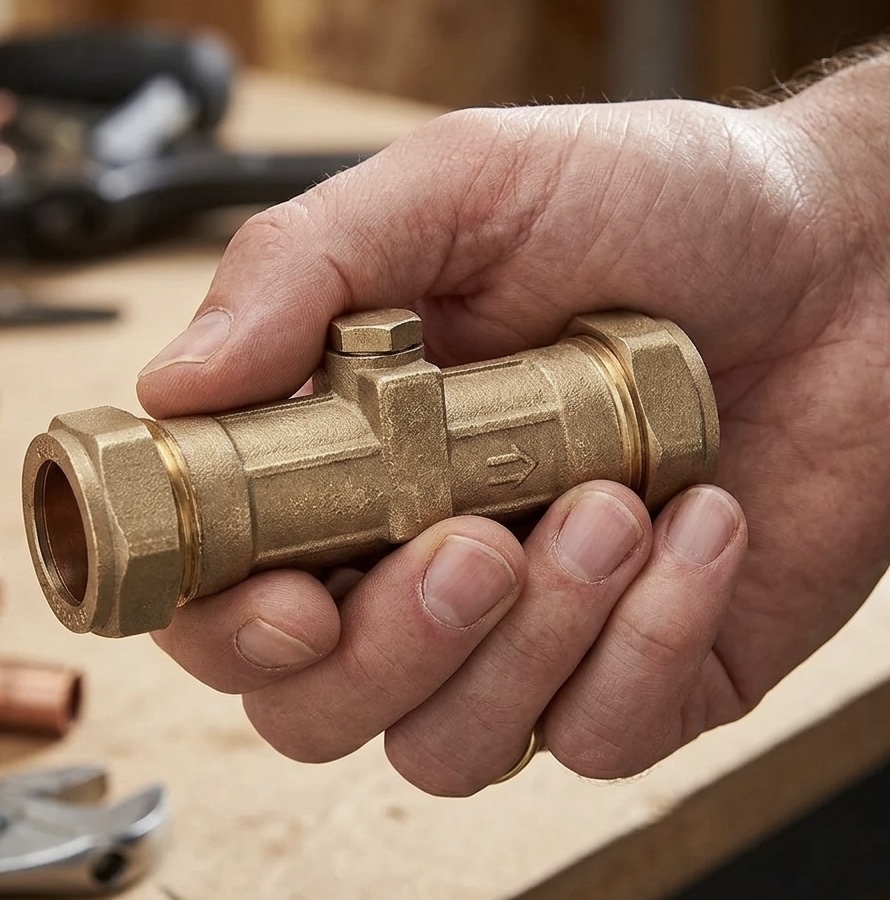
A non-return valve (also called a check valve) does exactly what the name suggests — it lets water flow in one direction and blocks it from going backwards. They're simple, cheap, and solve a surprisingly common problem in domestic plumbing. Here's how they work, where you need them, and how to fit one.
How a Non-Return Valve Works
Inside the valve is a spring-loaded disc or flap. When water flows in the correct direction (with the arrow on the body), the pressure pushes the disc open and water passes through. When water tries to flow backwards — against the arrow — the disc is pushed shut by the reverse pressure and the spring holds it closed. Nothing gets through.
That's it. No electronics, no moving parts that need maintenance, no power. Just a brass body, a spring, and a rubber-seated disc. They're typically 15mm or 22mm compression fittings and they install inline on copper pipe just like any other fitting.
The arrow matters
Every non-return valve has an arrow stamped or moulded on the body showing the direction of permitted flow. If you fit it the wrong way round, it blocks the flow entirely — no water will come through at all. Always check the arrow points in the direction the water needs to travel before you tighten up.
The Backflow Problem
Backflow is when water travels the wrong way through a pipe. It happens when two supplies at different pressures meet — the higher-pressure supply pushes water back down the lower-pressure one. The most common scenario in a house:
Hot water running cold at the tap
You turn on the hot tap. The flow is weak — maybe it's a gravity-fed hot water cylinder with low pressure. Then you turn on the cold tap, which is mains-fed and much higher pressure. The cold water is so much stronger that it pushes back down the hot pipe. Now the hot tap is running cold even though the cylinder is full of hot water.
You close the cold tap, wait a minute, and the hot comes through again. Open both taps together, and the hot goes cold. This is backflow, and it's solved with a non-return valve on the hot supply under the sink.
Why it matters beyond comfort
Backflow isn't just annoying — it can be a water safety issue. If contaminated water from one source gets pushed back into a potable supply, it's a health risk. That's why water regulations require non-return valves (specifically, double check valves) on certain installations like outside taps, where a hose could siphon garden chemicals back into the mains supply.
Where You Need Non-Return Valves
- Hot water supply to taps. If you have a gravity-fed hot water system (cylinder in the airing cupboard, cold tank in the loft) and mains-pressure cold water, a non-return valve on the hot supply under each sink prevents the cold pushing back into the hot. This is the most common domestic use.
- Outside taps. Water regulations require a double check valve on any outside tap to prevent contaminated water being siphoned back into the mains supply. If your outside tap doesn't have one built in, a separate double check valve must be fitted on the supply pipe. See our outside tap fitting guide for details.
- Combi boiler cold supply. Combi boilers have a non-return valve built into the cold mains inlet to prevent heated water from the heat exchanger pushing back into the mains supply.
- Mixer taps and showers. Where hot and cold supplies at different pressures meet in a mixer valve, a non-return valve on the lower-pressure supply prevents cross-flow. Some mixer taps have them built in — check the manufacturer's instructions.
- Unvented hot water cylinders. These have a non-return valve (and other safety devices) on the cold inlet to prevent thermal expansion from pushing hot water back into the mains.
Check valve vs non-return valve
These terms are used interchangeably in domestic plumbing. A "check valve" and a "non-return valve" are the same thing. A "double check valve" has two non-return mechanisms in series for extra protection — required on outside taps and certain commercial installations. For most under-sink applications, a single check valve is fine.
How to Fit One (Under a Sink)
Fitting a non-return valve on the hot supply under a basin or kitchen sink is a straightforward compression fitting job. Here's the process:
What you need
- 15mm non-return valve (single check valve)
- Short length of 15mm copper pipe (if needed to extend the run)
- 15mm compression olives and nuts
- Two adjustable spanners
- Pipe cutter
- PTFE tape or jointing compound
- Towel and small container
Step by step
- Turn off both hot and cold isolation valves under the sink. Open both taps to confirm they're off.
- Disconnect the hot flexible connector from the isolation valve or copper pipe. Have a towel underneath — there'll be residual water in the hose.
- Work out the valve position. The non-return valve sits between the isolation valve and the flexible connector going up to the tap. The arrow on the valve must point upwards — in the direction of flow towards the tap.
- Cut a short piece of copper pipe if you need to bridge the gap between the isolation valve and the non-return valve inlet. Fit a nut and olive onto each end.
- Assemble the non-return valve onto the pipe with compression fittings. Check the arrow direction one more time before tightening.
- Reconnect the flexible connector to the outlet of the non-return valve.
- Turn the isolation valves back on. Check every connection for leaks. Run the hot tap and confirm you get hot water — this also confirms the valve is the right way round. If you get no flow at all, the valve is backwards.
Check there's enough pressure
A non-return valve needs a small amount of pressure to push the internal disc open. On a strong mains supply, this isn't an issue. But on a weak gravity-fed hot water system, the added resistance of the valve can reduce the already-low flow at the tap. If the hot water pressure is very poor before fitting the valve, it may be noticeably worse after. In that case, the underlying pressure issue needs addressing — a non-return valve isn't the right fix if there's barely any pressure to begin with.
Things to Watch Out For
- Arrow direction. Worth saying again. Fit it backwards and you get zero flow. It's the most common mistake.
- Noise. Some non-return valves click or chatter when flow is intermittent (tap barely open). This is the disc bouncing between open and closed. It's normal and harmless, but it can be annoying. Higher-quality valves with better springs are quieter.
- Debris. A piece of solder, scale, or pipe debris can jam the disc partially open, defeating the purpose of the valve. If a newly fitted non-return valve doesn't seem to be preventing backflow, the disc may be held open by debris. Turn the water off, remove the valve, inspect and clean it, and refit.
- Freezing. Non-return valves on outside tap runs can freeze in winter. If the valve body cracks from frozen water, it'll leak when it thaws. Drain the outside tap run and close the isolation valve before winter — the non-return valve will drain with the rest of the pipe.
- Don't confuse with a pressure reducing valve. A PRV reduces water pressure. A non-return valve prevents backflow. They do completely different things and are not interchangeable.