Toilet Keeps Running After Flushing? How to Fix It
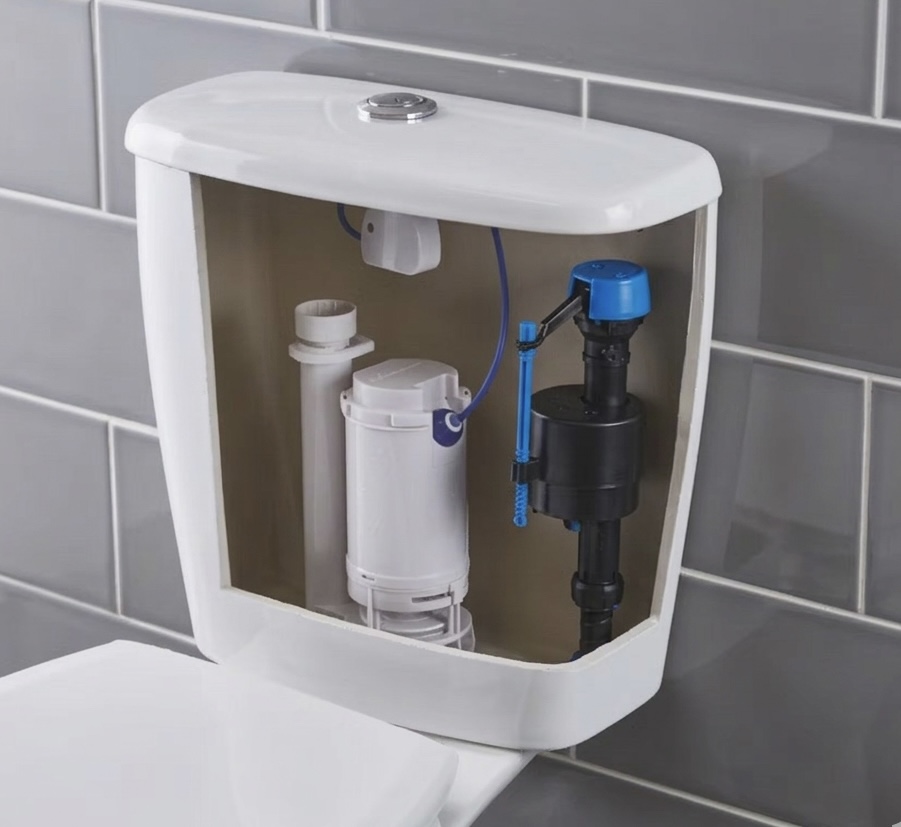
You flush the toilet, everything works as normal, but then the water just keeps trickling into the bowl. It never stops. The cistern fills up but there's a constant gentle stream running into the pan. It's wasting water, it's annoying, and if you're on a water meter it's costing you money. The good news is this is almost always a simple fix.
How a Push-Button Flush Works
Understanding the mechanism makes diagnosing the problem much easier. A modern push-button toilet has two main components inside the cistern:
- The fill valve — lets water into the cistern from the mains supply. It has a float that rises with the water level and shuts the valve off when the cistern is full.
- The flush valve (flush unit) — sits in the centre of the cistern. When you press the button, a plunger lifts up, opening a seal at the bottom and releasing water into the toilet bowl. Once the water level drops, a float on the flush unit drops with it and the seal closes again, stopping the flush.
Most push-button flush units have two buttons — a small one for a half flush and a large one for a full flush. Each button operates a different float at a different height, controlling how much water is released.
When the toilet "keeps running", water is getting past the flush valve seal and trickling into the bowl continuously. There are four common reasons for this.
Cause 1: Fill Valve Is Set Too Fast
This is the most common cause and the easiest to fix. If the fill valve is letting water into the cistern too quickly after a flush, the water level rises so fast that the flush valve's float never drops far enough to close the seal properly. The seal hovers just above the seat, and water trickles past it continuously.
How to fix it
- Take the cistern lid off. On push-button toilets, you usually need to unscrew the button ring (turn it anti-clockwise), lift the button off, then lift the lid.
- Flush the toilet and watch what happens. If the water refills so fast that the flush valve barely moves down before it's full again, the fill rate is too high.
- Find the fill valve — it's on one side of the cistern with the water supply pipe connected to the bottom.
- There will be a small inline valve or adjustment screw on the fill valve or on the pipe below it. If it's an inline valve, it'll have a slot you can turn with a flat-head screwdriver. Turn it to partially close it — you want to reduce the flow rate, not shut it off completely.
- Flush again and watch. The cistern should fill more slowly, giving the flush valve time to fully close before the water level rises past the float.
How slow is slow enough?
The cistern should take roughly 60–90 seconds to refill after a full flush. If it's filling in 15–20 seconds, it's too fast. You don't need it to be instant — you need it to be slow enough that the flush valve has time to seal before the water level overwhelms it.
Cause 2: Debris Under the Flush Seal
The flush valve has a rubber seal at the bottom that sits on a plastic seat. When the seal drops back down after a flush, it needs to land on a perfectly clean surface to make a watertight seal. A tiny piece of limescale, grit, or even residue from those coloured cistern tablets can hold the seal open just enough for water to trickle through.
How to fix it
- Turn off the water supply to the cistern (isolation valve or stopcock).
- Flush to empty the cistern.
- Lift out the flush unit. On most models, the top section (the part with the buttons and floats) twists and lifts out of the base. Give it a quarter-turn anti-clockwise and pull it up.
- Run your finger around the plastic seat that the rubber seal sits on. Feel for any grit, limescale, or roughness. Clean it thoroughly — a cloth and some white vinegar works well for limescale.
- Check the rubber seal itself. If it's got deposits or grime on the sealing face, wipe it clean.
- Refit the flush unit, turn the water back on, and test.
Those coloured cistern tablets
The ones you drop into the cistern to make the water blue or to "keep it fresh". They're a common cause of this exact problem. The dye and chemicals leave a residue on the flush valve seat that prevents the seal from closing cleanly. They can also degrade rubber seals and plastic components over time. If you're using them and your toilet runs — take them out and clean the flush valve seat. That may be all it takes.
Cause 3: Worn Flush Valve Seal
The rubber seal at the bottom of the flush valve is a wear part. Over time it goes hard, warps slightly, or develops a ridge where it sits against the seat. Once it loses its flexibility, it can't form a clean seal and water seeps past it.
How to fix it
- Turn off the water and flush the cistern to empty it.
- Remove the flush unit top section (twist and lift).
- The rubber seal is on the bottom of the plunger — it usually pulls off by hand. Some are a simple ring, others are a cup-shaped washer.
- Take the old seal to a plumbing supplier or look up the flush unit model online. Replacement seals are cheap and widely available. If you can't find an exact match, universal seals in standard sizes work for most units.
- Fit the new seal, reassemble, refill, and test.
This is a five-minute job once you've got the right seal. If the rubber has gone hard or is visibly deformed when you pull it off, that's almost certainly your problem.
Cause 4: Water Level Set Too High (Overflow)
Modern flush units have a built-in overflow — a tube or channel that directs water into the toilet bowl if the cistern overfills. This is a safety feature: instead of flooding onto the bathroom floor, excess water goes safely into the pan.
If the fill valve's float is set too high, the cistern fills past the overflow level and water constantly trickles down the overflow into the bowl. It looks and sounds identical to a flush seal problem, but the cause is different — the seal is fine, it's the water level that's wrong.
How to check
Take the lid off and flush. Watch the water refill. If the water rises to the very top of the flush unit's overflow tube and starts spilling over the edge into it, the fill valve is set too high.
How to fix it
Adjust the fill valve float so it shuts off at a lower water level. Most modern fill valves have an adjustable float — either a screw you turn to raise or lower the shut-off point, or a clip on the float arm that you slide up or down. The water should stop filling about 25mm (1 inch) below the top of the overflow.
Still Running? When the Flush Unit Needs Replacing
If you've tried all four fixes and the toilet still runs, the flush unit itself is likely past its useful life. Common failures beyond the seal:
- A float that's taken on water. If one of the flush valve floats has cracked or become waterlogged, it can't rise properly and won't close the seal. You can sometimes see this — the float sits lower in the water than it should.
- A damaged seat. If the plastic seat that the seal sits on is scratched, cracked, or warped, no seal will sit cleanly on it. The seat is part of the base unit, so you'd need to replace the entire flush valve.
- A worn plunger mechanism. If the plunger that lifts and drops the seal isn't moving freely, it might not be dropping fully closed after a flush.
Replacement flush units are available for most toilet models and are straightforward to fit — you turn off the water, empty the cistern, unscrew the large nut underneath, swap the unit, and reconnect. But if you're not comfortable working underneath the cistern, it's a quick job for a plumber.
How much water does a running toilet waste?
A toilet that runs continuously can waste 200–400 litres of water per day. On a water meter, that's roughly £1–2 per day, or £400–700 per year. A replacement flush seal costs under £5. Even a full replacement flush unit is under £20. It's one of those rare cases where the fix pays for itself within a day.