How to Install Shower Wall Boards: Complete Guide
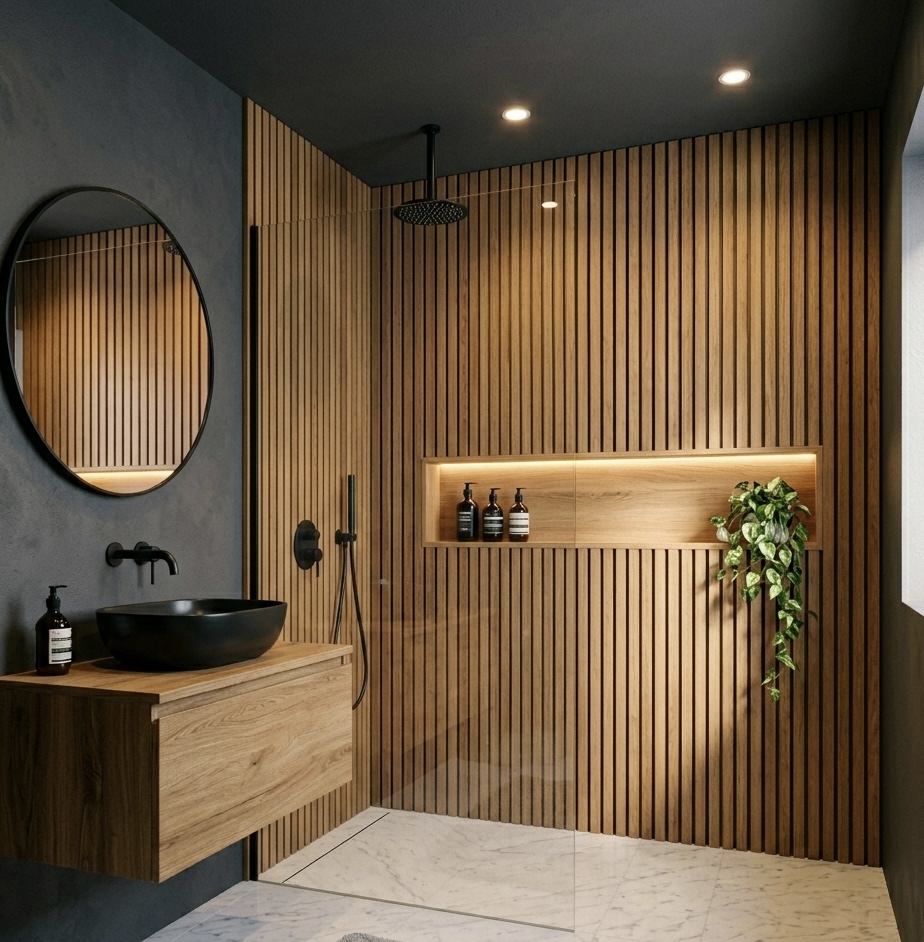
Shower wall boards are the best tile alternative available right now. No grout, no wet trades, no waiting days for adhesive to cure. They go up in a day, they're completely waterproof when sealed properly, and they look as good as — or better than — tiles. But the "sealed properly" part is critical. Get the joints and corners wrong and moisture gets behind the boards, which eventually blows them off the wall. Here's the complete process for a watertight, professional installation.
Wall Preparation and Substrate
Fibre-backed shower boards can go onto most surfaces — plasterboard, stud work, existing tiles, even patched plaster where old tiles have been removed. The key requirement is that the surface is solid and stable. No loose plaster, no blown adhesive, no crumbling areas.
Before you start, go around the wall and tap it. If it sounds hollow, press on it. If the surface moves or crumbles, scrape it back to something solid. You don't need a perfectly flat wall — the adhesive behind the boards takes up minor unevenness — but you do need a surface that won't fall off the wall after the boards are up.
Measuring and Planning
Fibre shower boards are typically 600mm wide and 2400mm tall. They're not cheap — roughly £100–125 per board — so a wrong cut is expensive. Measure twice, cut once is the rule here.
Which wall first?
Start with the back wall of the shower (the wall opposite the opening). This is the easiest to fit because it's a full-width wall with no obstacles. The side walls then butt into the back wall at the corners, which gives cleaner internal corner joints.
Taking measurements
- Measure the height at both the left and right edges of where the board will sit. Ceilings and shower trays aren't always perfectly level — a 1–2mm difference between sides is normal and the silicone seal will absorb it. A bigger difference means your ceiling or tray is out of level.
- For width cuts (ripping boards to fit a gap), take three measurements — top, middle, and bottom. Walls are rarely perfectly plumb, so you'll likely get three slightly different numbers.
- Write every measurement down. Sketch a simple plan if it helps. Transfer the measurements to the board before cutting.
Measure from the face, not the tongue
When measuring width, measure from the decorative face of the board, not from the tongue edge. The tongue adds extra width that slots behind the adjacent board — if you measure from the tongue, the board will be too wide.
Cutting the Boards
Use a circular saw with a sharp, fine-toothed blade. A track saw is ideal if you have one, but a standard circular saw with a straight-edge guide works perfectly.
Decorative face DOWN when cutting
A circular saw blade cuts upward through the material. If the decorative face is facing up, the blade will chip the surface as it exits. Turn the board face-down so the blade cuts up into the decorative face from behind — any chipping happens on the back where it doesn't matter. If you're using a track saw with a splinter guard, face-up is fine.
Cut on a flat surface. A sheet of rigid insulation board underneath works well — the saw blade passes through the shower board and into the insulation without damaging the floor. Set your blade depth to just a couple of millimetres more than the board thickness.
For pipe holes, use a hole saw in a drill. A 30mm hole saw suits standard 15mm pipe with clearance. Mark the hole position by measuring from the board edges to the pipe centres, transfer the marks to the board, and drill through from the decorative face.
Applying Adhesive
Use a proper panel adhesive — not silicone. Silicone is flexible and doesn't have the grab strength to hold a heavy board to the wall permanently. A hybrid sealant/adhesive (like a grab adhesive rated for wet areas) gives the structural bond you need.
Apply the adhesive in thick vertical lines on the back of the board, spaced roughly 200mm apart, with a horizontal line across the top and bottom. This pattern gives full coverage while allowing you to press the board flat against the wall.
Cut the nozzle with a large opening — you need a generous amount of adhesive. These boards are heavy and the adhesive needs to make full contact. Thin, stingy lines of adhesive will result in boards that move or eventually come away from the wall.
Fitting the First Board
Tip the board in from the bottom, pressing the base against the shower tray first, then push the top back against the wall. Press firmly across the whole surface to get good contact between the adhesive and the wall. The adhesive should grab immediately, holding the board in position while it cures.
Check it's plumb with a spirit level. You have a minute or so to adjust before the adhesive starts to set. The first board sets the line for everything else — if it's out of plumb, every subsequent board will be too.
Click Joints and Sealing
Quality fibre boards have a tongue-and-groove click system. One edge has a leading tongue, the other has a receiving groove. The next board clicks into the previous one at an angle, then pushes flat against the wall.
Silicone on the tongue BEFORE clicking
This is the most important step for waterproofing. Before you click the next board in, run a bead of clear sanitary silicone along the leading tongue from top to bottom. When the boards click together, the silicone seals the joint from behind. If you don't do this, water can wick into the tongue-and-groove joint and get behind the boards. You'll see excess silicone squeeze out of the face of the joint when you click it together — that's a good sign. It means the joint is fully sealed.
Once clicked together, spray the joint line with soapy water and run a silicone profiling tool along it to remove the excess silicone from the surface. The soapy water stops the tool dragging the silicone out of the joint. Wipe clean with a cloth. The result is a sealed joint with no visible silicone on the face.
Internal Corners (No Trims)
You can buy internal corner trims, but in a shower where water hammers the corners constantly, trims are a weak point. A silicone joint — done the same way as tile corners — is more reliable.
Two-stage corner seal
- Stage 1: before pushing the board into the corner, run a bead of clear silicone down the edge that butts against the adjacent board. Press the board into the corner. The silicone seals behind the joint.
- Stage 2: once all boards are up and the adhesive has set, come back and run a finishing bead of silicone into the corner from the front. Profile it with a silicone tool for a clean, concave finish — exactly like you'd seal a tile corner.
Two layers of defence. The first seal behind the board stops water getting in. The visible seal on the front stops water reaching the first seal. Belt and braces.
Scribing to Uneven Walls
Walls are rarely perfectly straight or plumb. When a board meets a wall in a corner, there's often a gap that's wider at one end than the other. Scribing transfers the shape of the wall onto the board so you can cut it to fit perfectly.
- Hold the board in position against the wall. You'll see the gap varies from top to bottom.
- Take a small offcut block — slightly wider than the biggest gap.
- Hold a pencil against the block and run both along the wall from bottom to top. The pencil transfers the wall's shape onto the board.
- Cut along the pencil line with a jigsaw or circular saw.
- The board now matches the wall contour and fits tight with no gaps.
Cutting Around Pipes
Shower mixer pipes are typically at 150mm centres (centre to centre). Measure from the edge of the board (where it meets the corner) to the centre of each pipe, and from the bottom of the board (shower tray) up to the centre height. Transfer these two measurements onto the board — they give you the centre point for each hole.
Drill the holes with a hole saw slightly larger than the pipe diameter (30mm for 15mm pipe is typical). Once the board is up with the pipes through the holes, cover the gap with a pipe collar or escutcheon plate for a neat finish.
External Corners and End Trims
Where a board finishes at an exposed edge (not in a corner), fit an end trim. The trim slots over the edge of the board and is held in place with silicone adhesive. Apply silicone to the inside of the trim before pressing it on — this seals the exposed board edge and prevents moisture getting into the ply layers.
External corners (where two walls meet at an outside angle) use a specific external corner trim. One board finishes flush with the corner, the trim slots onto its edge, and the second board slots into the other side of the trim. Silicone in the trim channels before assembly — same principle as everywhere else: seal every edge.
Final Silicone Sealing
Once all boards, trims, and corners are fitted and the adhesive has set, the final step is silicone sealing every perimeter joint:
- Around the shower tray — white or clear silicone, profiled with a silicone tool. This is the joint that sees the most water. Use a profiling tool, not your finger.
- Internal corners — the stage 2 finishing seal (see above). Clear silicone profiled cleanly.
- Where boards meet the ceiling — a bead of white silicone to stop moisture getting behind the top edge.
- Around pipe holes — if the collar or escutcheon doesn't fully seal, a small bead of silicone around the base.
Always use sanitary silicone
In a shower, always use mould-resistant sanitary silicone. Standard silicone doesn't have the fungicide and will go black within months. This applies to every seal — joints, corners, tray, ceiling. One tube of the wrong silicone can ruin the look of a £500+ installation.