How to Install a Boiling Water Tap: Complete Guide
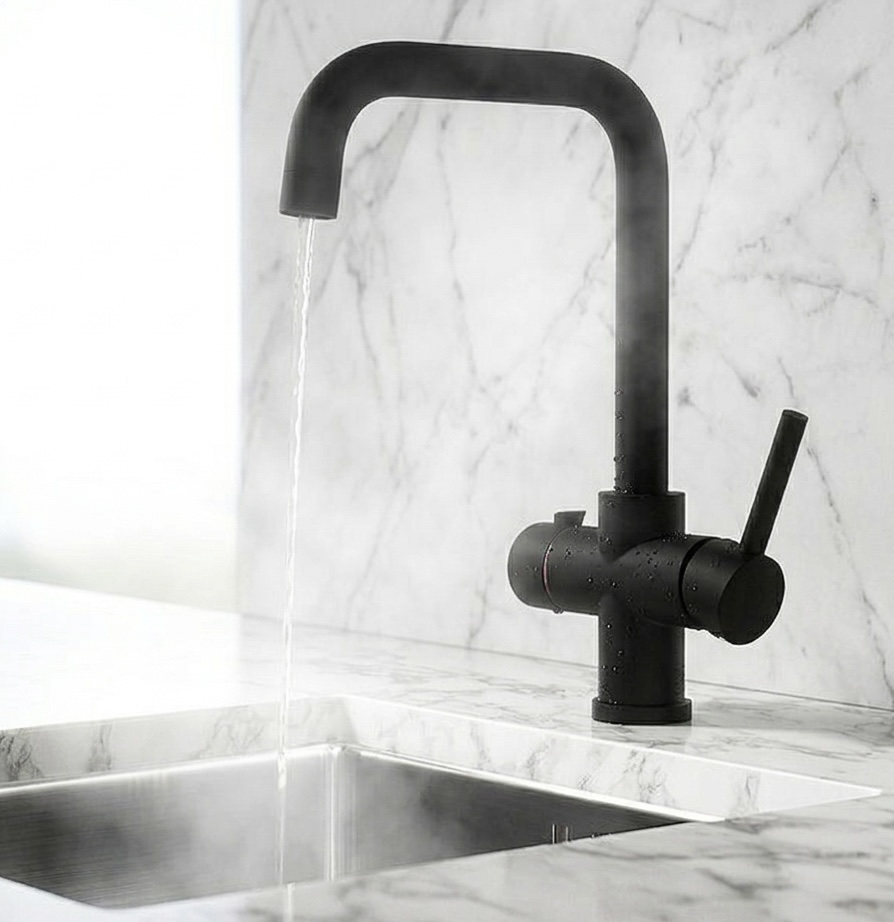
Boiling water on demand — no waiting for the kettle, no wasted energy, no worktop clutter. Boiling water taps have become one of the most popular kitchen upgrades going, and the good news is the installation is well within DIY reach. If you can connect a tap and tighten a few fittings, you can do this.
What You’re Working With
A boiling water tap system has three main components that all sit under the sink and connect to the tap above:
- The tap itself — looks like a standard kitchen mixer tap but has an additional lever or button for dispensing boiling water. Most have a spring-loaded safety mechanism so you can’t accidentally release boiling water.
- The boiler unit (tank) — a compact insulated tank that heats and stores water at near-boiling temperature. Plugs into a standard 13A socket. Sizes vary but most fit comfortably in a standard base unit.
- The carbon filter — sits between the cold supply and the boiler. Removes chlorine, sediment, and impurities from the water before it reaches the tank. This protects the boiler from scale build-up and improves the taste of the water.
You’ll also find in the box: three flexible tap tails (hot, cold, and filtered water), a length of PE tube for the filter connections, various push-on and threaded adapters, a mounting plate, an O-ring, a locking nut, and a silicone tube that runs from the boiler to the tap. There should be an installation diagram — keep it handy because it shows you which tap tail goes into which hole on the bottom of the tap.
Before You Start
Pre-installation checklist
- 13A socket under the sink — the boiler unit needs a permanent power supply. If you don’t have a socket inside the base unit, you’ll need one installed. Do not use an extension lead — it’s a heat-producing appliance near water.
- Sink hole — most boiling water taps need a 35mm hole. If you’re replacing an existing single-lever tap, the hole is usually the right size already. Check the manufacturer’s spec sheet.
- Isolation valves — you need working isolation valves on both the hot and cold supply pipes under the sink. If you don’t have them, now is the time to fit isolation valves before you go any further.
- Water pressure — most boiling water taps need a minimum of 1 bar on the cold supply. If you’re in an area with low mains pressure or a gravity-fed system, check the specs before buying.
- Space in the base unit — the boiler tank needs ventilation around it. Clear enough room so it’s not jammed against the back wall or surrounded by cleaning products.
Turn off both isolation valves and disconnect your old tap before you begin. If you’re not sure how to remove the existing tap, our guide to changing a kitchen tap covers the removal process in detail.
Fitting the Tap to the Sink
Start by assembling the tap upside down on the worktop before dropping it into the hole. This is much easier than trying to attach everything from underneath.
- Insert the threaded rod. The tap comes with a fixing nut and a threaded rod. Unscrew the rod from the fixing nut. You’ll notice the rod has a smaller set of threads at one end — that end goes up into the bottom of the tap. Slide it in and tighten it hand-tight.
- Fit the three tap tails. Your installation diagram shows which tap tail goes into which hole. Thread each one down into its corresponding hole on the bottom of the tap. They’re a hand-tight fit — no tools needed. Don’t force them or over-tighten, and take care not to kink any of the flexible pipes.
- Check the silicone tube. You’ll notice a silicone tube hanging from the bottom of the tap that connects down to the boiler unit. This comes pre-installed — leave it as it is.
- Slide on the mounting plate and O-ring. These go over the tap tails and sit under the tap body, ready to rest on the top of the sink.
- Drop the tap into the sink hole. Feed each tap tail through the hole one at a time, then lower the tap into position.
Now come underneath the sink to secure it:
- Slide the rubber O-ring up over all the tap tails and push it right up against the underside of the sink.
- Thread all the tap tails and the boiler hose through the locking nut.
- Slide the locking nut up and tighten it fully against the underside of the sink.
Stop the tap spinning
Have someone hold the tap from above while you tighten the locking nut from below. Without a second pair of hands, the tap will just spin on the worktop as you tighten. If you’re working alone, a strip of masking tape across the tap base onto the sink can hold it in place temporarily.
Some taps include a retaining plate for thin or flexible sinks (typically metal sinks). If your sink is solid composite or ceramic, you probably won’t need it — the locking nut alone will hold the tap firmly. If the sink flexes when you push down on it, use the retaining plate for extra stability.
Positioning the Boiler Unit
Before you connect anything, plug the boiler unit in. You don’t want to plumb everything up perfectly only to discover the power cable doesn’t reach the socket. Plug it in but leave the switch off for now.
Place the boiler unit inside the base unit, keeping three things in mind:
- Reach. The silicone tube from the tap needs to reach the outlet on top of the boiler. Don’t position it so far back that the tube is stretched tight.
- Ventilation. Leave a gap around the unit — it generates heat and needs airflow. Don’t wedge it against the back panel or surround it with items.
- Access to isolation valves. Make sure you can still reach the hot and cold isolation valves (and the stopcock if it’s in the same cupboard). In an emergency, you don’t want to be wrestling a boiler tank out of the way to turn the water off.
Electrical safety
The boiler must plug into a dedicated 13A socket — not an extension lead, not a multi-plug adapter. It draws a significant amount of power when heating, and it’s sitting under a sink near water. If there’s no socket inside the base unit, get one installed by a qualified electrician before proceeding. This isn’t something to bodge.
Mounting the Carbon Filter
The carbon filter needs to be mounted somewhere inside the base unit where you can easily access it for replacement. Most filters twist out of a housing — you lift up and turn to release them — so you need enough clearance above the filter to do that.
- Position the filter housing as close to the boiler tank as practical. This keeps the PE tube runs short and tidy.
- Drill a few small pilot holes into the side panel of the base unit.
- Screw the filter housing bracket to the side of the cabinet.
Don’t mount it behind the boiler or in a spot where you’d need to remove the tank to change the filter. You’ll be doing this every three to six months — it needs to be quick and painless.
Connecting the Hot and Cold Supplies
With everything positioned, it’s time to make the plumbing connections. Make sure your isolation valves are turned off before you start.
- Identify the tap tails. Your diagram tells you which is hot and which is cold. Locate the domestic hot pipe and connect the hot tap tail to it.
- Tighten gently. Use an adjustable spanner to snug up the connection. Don’t overtighten — these are flexible tap tails with rubber O-ring seals inside. Over-tightening risks kinking the pipe or crushing the O-ring, which causes leaks rather than preventing them.
- Repeat for the cold. Connect the cold tap tail to the domestic cold supply pipe.
That’s the standard hot and cold done — these work exactly the same as a normal kitchen tap connection. The third tap tail is the filtered water supply, which goes through the filter and into the boiler. That’s next.
Plumbing the Filter and Boiler
This is where it differs from a standard tap install. You’re connecting three things: the filtered water tap tail to the filter, the filter to the boiler inlet, and the boiler outlet back up to the tap.
Tap tail to filter
- Find the half-inch adapter that came in the filter box. Thread it onto the tap tail labelled “water filter”. It’s plastic — hand-tight only, no spanner.
- Cut a length of PE tube and push it firmly into the adapter until it clicks or bottoms out.
- Run the other end of the PE tube into the filter inlet and push it in until seated.
Filter to boiler inlet
- On the boiler, locate the blue inlet fitting. Thread on the three-eighths to half-inch BSP adapter that came with the boiler — hand-tight. Make sure the O-ring inside hasn’t dropped out. If the O-ring is missing, it won’t seal.
- Fit the half-inch to PE pipe adapter onto the boiler inlet — again, hand-tight.
- Cut another length of PE tube. Push one end into the filter outlet and the other into the boiler inlet adapter.
- Tuck the PE tube out of the way so it can’t get caught or kinked.
Hand-tight means hand-tight
Every adapter on the filter and boiler is designed to seal with an O-ring. If you reach for a spanner and crank these down, you’ll crush the O-ring or crack the plastic fitting. Hand-tight is all they need. If one leaks later, the O-ring is misaligned or missing — tightening harder won’t fix it.
Boiler outlet to tap
- On the boiler, locate the red outlet fitting. Thread on the push-on adapter — hand-tight, no spanner.
- Take the silicone tube that hangs from the tap (the one that was pre-installed) and push it down onto the barbed fitting on the boiler’s red outlet.
- Slide the retaining clip down over the tube to lock it in place. Use a pair of grips to push the clip fully home — you don’t want this coming off, as it carries near-boiling water.
Testing for Leaks
Do not turn the boiler on yet. Test the plumbing with cold water first.
- Open the hot isolation valve. Listen for water flowing and check every connection on the hot side.
- Open the cold isolation valve. Again, listen and check.
- Run your finger over every fitting — tap tails where they enter the tap body, the connections to the supply pipes, the filter adapters, and every fitting on the boiler. Feel for any dampness at all.
- If anything weeps, turn off the supply and check that fitting. Usually it’s an O-ring that’s not seated properly or a PE tube that wasn’t pushed in far enough.
Once you’re satisfied there are no leaks on the cold side, test the normal tap functions. Run the hot and cold as you would on any kitchen tap. Everything should work exactly as a standard mixer at this point.
Priming the Tank and First Use
The boiler tank needs to be filled with water before you switch it on. Running it dry will damage the heating element.
- Activate the boiling water lever. Most boiling water taps have a spring-loaded safety handle — you turn or push it to open the boiling water channel. Open it now.
- Wait for water to flow. Cold water from the mains passes through the filter, fills the boiler tank, and eventually comes out of the tap. This takes roughly 90 seconds depending on your water pressure.
- Flush for three minutes. Once water is flowing steadily, leave it running for about three minutes. This flushes any manufacturing residue, loose carbon particles from the new filter, and air from the system.
- Check underneath again. While the water is flowing, go back under the sink and recheck every fitting. Connections that were dry under static pressure can sometimes weep once water is actually flowing through them.
Now you can turn the boiler on:
- Flick the power switch on the boiler unit.
- The display will show the current water temperature (likely around 15–20°C) and the target temperature (usually 98°C by default).
- You can adjust the target temperature using the controls on the unit. Most people set it between 95–98°C.
- The unit will now heat up. Depending on the tank size, this takes 5–15 minutes for the first heat cycle.
Once it reaches temperature, open the boiling water lever on the tap and test. You should get instant, near-boiling water. The tank will automatically reheat after each use.
Child safety
The spring-loaded safety mechanism on the boiling water lever exists for a reason — you have to deliberately push or twist it to dispense. Make sure everyone in the household understands how it works, and that it’s not the same as the normal hot and cold lever. Some models also have a child lock feature that can be activated on the boiler unit itself. If you have young children, check whether your model has this and enable it.
Maintenance — Filters and Descaling
A boiling water tap isn’t a fit-and-forget appliance. Two things need regular attention:
Filter replacement
The carbon filter needs replacing every three to six months, depending on your water quality and how much boiling water you use. Most manufacturers recommend every six months, but if you’re in a hard water area the filter will exhaust faster.
Cambridgeshire has notably hard water — particularly around St Neots, Huntingdon, and the surrounding villages where chalk aquifer water comes through at 250–350 ppm. If that’s you, lean towards the three-month end of the replacement schedule rather than waiting the full six.
Replacement filters typically cost £20–40 depending on the brand. The swap itself is straightforward — turn off the cold supply, release the pressure by opening the filtered tap, twist the old filter out, twist the new one in, turn the water back on, and flush for two minutes.
Descaling
Even with a filter, some limescale will build up inside the boiler tank over time. Most manufacturers recommend descaling annually. The process varies by model, but usually involves running a descaling solution through the system. Check your manual for the specific procedure — some units have a dedicated descale mode.
Ignoring the filter and descaling schedule is the single biggest reason boiling water taps underperform or fail early. The filter protects the tank. The descaling keeps the heating element efficient. Skip either one and you’ll notice slower heating, reduced flow, and eventually a tank replacement that costs more than the original tap.
Is it actually cheaper than a kettle?
A boiling water tap keeps a small tank at temperature constantly, which uses roughly 10–15p of electricity per day. A kettle uses more energy per boil but only when you use it. If your household boils the kettle four or more times a day, a boiling water tap works out roughly the same or cheaper — and the convenience factor is the real win. No more waiting, no more overfilling, no more limescale chunks floating in your tea.