How to Hang a Heated Towel Rail: Complete Guide
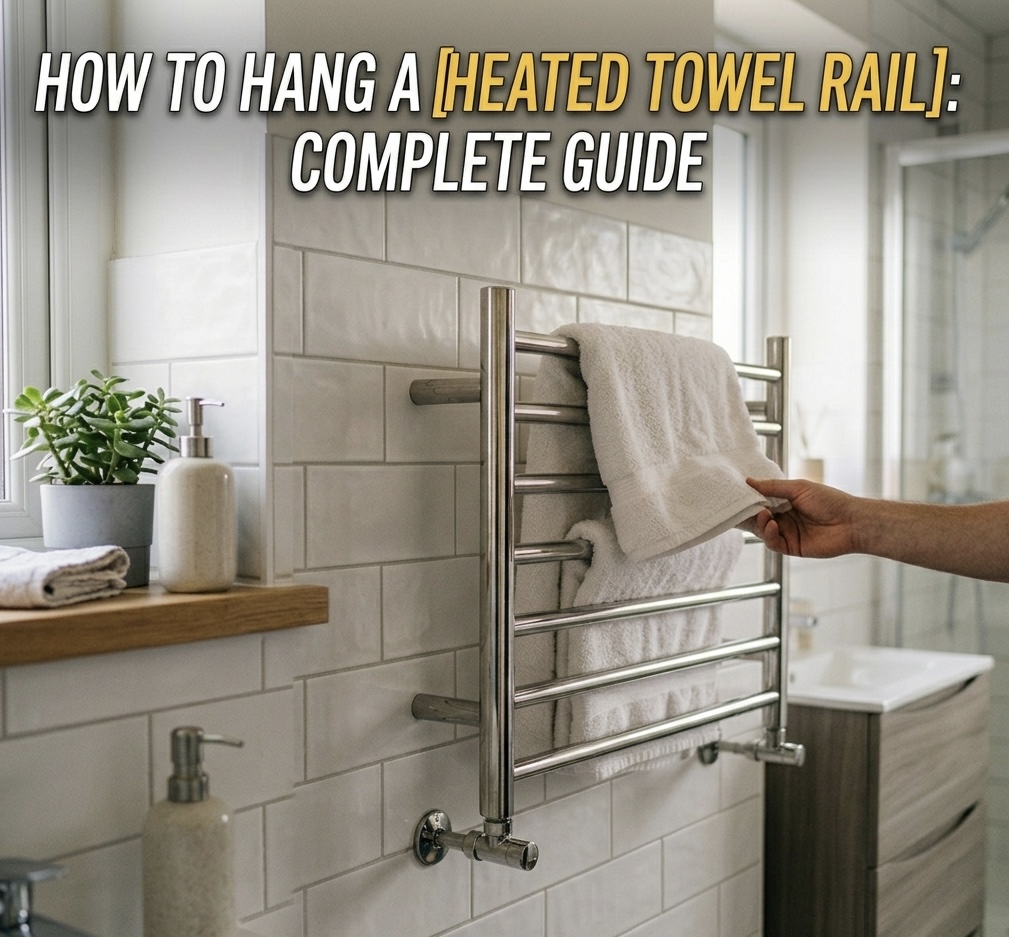
A heated towel rail is one of those bathroom upgrades that sounds more complicated than it actually is. The plumbing is identical to connecting any radiator — two valves onto two pipes. The fiddly bit is getting it level on the wall, especially when you’re drilling through tiles. Get the preparation right and the rest follows.
Tools and Materials
What you’ll need
- Adjustable spanner and grips
- Radiator allen key or radiator spanner (hex key that fits valve inserts)
- Spirit level (or laser level)
- Tape measure and pencil
- Drill with masonry bits (and tile drill bits if drilling through tiles)
- Screwdrivers (flat and Phillips)
- PTFE tape (or Loctite 55 thread sealant)
- Insulation tape or a cloth (to protect chrome fittings)
- Wall plugs and screws (usually supplied with the rail)
- Bleed key
Preparation — Bungs, Bleed Valve, and Valve Inserts
Lay the towel rail flat on its face. You’ll see four threaded holes — two at the top and two at the bottom.
Top holes
One top hole gets a bleed valve — a small brass fitting with a square key slot. The other gets a blanking plug (bung). Both come with rubber O-rings, so they seal without PTFE tape. Just nip them up hand-tight with a spanner — the O-ring does the work.
Bottom holes — fitting the valve tails
The two bottom holes are where the radiator valves connect. Your valve type depends on your pipe layout:
- Pipes coming from the wall: angled valves (the most common setup in bathroom refits)
- Pipes coming from the floor: straight valves
Each valve has two parts — the body that connects to the copper pipe, and a threaded tail that screws into the radiator. Separate the tail from the body and prepare it for fitting:
- Wrap PTFE tape around the valve tail thread. Wind it on clockwise (looking at the end of the thread) so it doesn’t unravel as you screw it in. Use about 10–12 wraps for a good seal. Alternatively, use Loctite 55 or a similar thread sealant if you prefer.
- Screw the tail into the radiator using a radiator allen key (hex key). These are inexpensive and essential — a standard allen key set won’t have the right size. Wind it in until it’s snug.
- Don’t overtighten. Towel rail threads are often softer than a standard radiator. If you go too hard, you’ll strip the thread and the whole rail is scrap. Firm is enough — the PTFE is doing the sealing, not brute force.
Repeat on the other side.
Protect the chrome
Before putting a spanner on any chrome fitting, wrap a strip of insulation tape around it. One layer is enough. Without it, the spanner jaws will scratch the chrome and you’ll see those marks every time you look at the rail. A cloth works too, but tape stays put while you work.
Fitting the Wall Brackets to the Radiator
Every towel rail comes with wall mounting brackets. The design varies between manufacturers, but the principle is the same: one part bolts to the wall, the other clips around the rail, and a grub screw locks the two together so you can make fine adjustments once it’s on the wall.
- Check the instructions for the bracket positions. They’ll specify a measurement from the side of the rail and which bar to mount under. If your rail has four brackets (two top, two bottom), each pair will have a different measurement.
- Slide the bracket onto the rail from the inside, with the retaining clip loosely in place. Don’t tighten yet.
- Measure and position. Use your tape measure to set the bracket at the specified distance from the edge of the rail.
- Nip up the retaining clip just enough to hold the bracket in place. These are often plastic, so go easy — cracking one means a call to the manufacturer for a replacement.
If your instructions don’t specify bracket positions (some cheaper rails don’t), place them as far towards the outside edges as the rail allows. This gives the most stability and leaves the centre clear for hanging towels.
Marking Out the Wall Position
This is the step that makes or breaks the job. Take your time here.
Find your centre line
If your pipes are already coming out of the wall, measure between them and find the midpoint — that’s your centre line. If you’re working from scratch, measure the rail’s width, halve it, and mark the centre line on the wall where you want it.
Set the height
You need a way to hold the rail at the correct height while you mark the bracket positions. The easiest method is a stack of boxes, toolboxes, or anything sturdy enough to support the weight temporarily. Set the rail on top at the height you want, check it looks right, and adjust until you’re happy.
Height guidance
Building Regulations don’t specify a minimum height for towel rails, but practically speaking you want the bottom of the rail at least 150mm off the floor for cleaning access, and the top of the rail at a comfortable reach — around 1,200mm from the floor works for most people. If it’s above a bath, ensure the bottom rail is at least 600mm above the rim to comply with electrical zone requirements (Zone 1) if you ever add an electric element later.
Mark the bracket holes
- Slide the wall-mount part of each bracket onto the radiator brackets.
- Push the rail back against the wall so the brackets sit flat.
- Place a spirit level across the top of the rail (or across the two top brackets). Get it perfectly level.
- Draw around each bracket with a pencil. These outlines are your reference zones.
- Lift the rail away and place a mark in the centre of each bracket outline where the screw hole will be.
Before you drill, offer the rail back up one more time and check that the valve tails line up with the pipe connections. A level rail that doesn’t reach its pipes is no use to anyone.
Drilling and Fixing the Brackets
Before you drill
Check what’s behind the wall. Use a pipe and cable detector to scan for hidden pipes and wiring. If it’s a stud wall (plasterboard on timber), make sure the fixings go into the studs or use appropriate plasterboard anchors rated for the weight. A towel rail full of water is heavy — a standard “ladder” style chrome rail can weigh 15–25 kg when filled. Plasterboard on its own won’t hold that.
Drilling through tiles
If you’re going through tiles, use a tile drill bit (usually a diamond or carbide-tipped bit) at slow speed with no hammer action to get through the tile face. Once you’re through the tile and into the wall behind, switch to a standard masonry bit and use hammer action to drill to the required depth for your wall plug.
Fixing the brackets
- Push the wall plug into the hole. If you’re behind tiles, push the plug past the tile and into the masonry — the plug needs to grip the wall, not the tile. You may need to trim the plug collar if it catches on the tile face.
- Line up the bracket over the hole. Drop the screw (with washer if provided) through the bracket and into the plug.
- Tighten until the bracket is firm against the wall. Don’t overtighten — these brackets are often zinc alloy or plastic and will crack under excessive force.
- Repeat for all brackets.
Make sure the grub screw holes on each bracket face outwards (towards the room, not towards the wall). You need to reach these with an allen key once the rail is hung — if they face the wall, you won’t be able to get to them.
Hanging the Rail and Connecting the Valves
With the brackets fixed, you can hang the rail. Lower it onto the brackets so the rail clips sit in the wall mounts, and at the same time guide the valve tails down onto the valve bodies on the pipe connections.
Connecting the valves
The valve tails drop into the valve bodies. There’s an O-ring inside each valve body that creates the seal, so you do not need PTFE tape on this connection — just thread the nut on and tighten it up.
- Start the nut by hand to avoid cross-threading.
- Tighten with an adjustable spanner. Firm is enough — the O-ring seals under light compression. Overtightening achieves nothing except a crushed O-ring and a leak.
- Repeat on the other side.
Copper pipes vs plastic pipes
If your pipes are copper and come from the wall, they’re rigid — connect the valves before you do the final levelling, because you can’t flex copper to meet a rail that’s already locked in place. If your pipes are plastic (barrier pipe or PEX) coming from the floor, you have more flexibility — you can level and lock the rail first, then connect the valves, because the pipe bends to meet them.
Levelling and Locking It in Place
With the valves connected and the rail sitting on the brackets, place your spirit level across the top. The brackets have a sliding adjustment that lets you move the rail in and out from the wall, and the grub screws on the sides lock the rail at the position you set.
- Adjust until level. Slide the rail left or right on the brackets, and adjust each bracket’s depth (distance from wall) until the spirit level reads true.
- Start the grub screws. Once level, get each grub screw started by hand with the allen key. Don’t fully tighten any single one first — start them all, recheck the level, then tighten them all evenly.
- Final check. Step back and look at it. Is it visually straight against the tile lines? Sometimes a rail can read level but look off if the tiles aren’t perfectly level themselves. Trust the spirit level, but if it looks obviously wrong, investigate.
Once the grub screws are tight, the rail is locked in position and should not move. Give it a firm push to confirm it’s solid.
Filling, Bleeding, and Leak Checking
If you’ve been working on a drained or isolated system, you now need to fill the rail and get the air out.
- Make sure the bleed valve at the top is closed.
- Open both radiator valves (the lock shield and the TRV or manual valve, whichever you have).
- Repressurise or refill the system. On a sealed (combi or system boiler) system, use the filling loop to bring the pressure back up to around 1–1.5 bar. On a gravity-fed system, the header tank will refill automatically.
- Open the bleed valve at the top of the rail. You’ll hear air hissing out as water pushes up from the bottom. Once water appears at the bleed valve (have a cloth ready), close it.
- Check every connection for leaks. Run your finger over the valve nuts, the valve body connections to the copper pipes, and the bleed valve and bung at the top. Any dampness at all means something needs attention — don’t leave it for “later”.
Turn the heating on and let the system come up to temperature. Check for leaks again once it’s hot — joints can weep when the metal expands under heat that were dry when cold. If everything holds, you’re done.
After installing — check the rest of the system
Adding a new towel rail changes the flow balance of your heating system. You might find that radiators in other rooms don’t get as hot as they did before, because the new rail is taking some of the flow. If that happens, the system needs balancing — adjusting the lock shield valves across all radiators to distribute flow evenly. This is especially common in older gravity-fed systems where the pump pressure is marginal.
Do you need a TRV?
Building Regulations (Part L) require thermostatic radiator valves on all new radiator installations — with one exception: the radiator in a bathroom that has no other heat source. If the towel rail is the only heating in the room, it can have a manual valve instead of a TRV. If there’s also underfloor heating or another radiator in the bathroom, the towel rail should have a TRV fitted.