How to Fix a Leaking Compression Fitting
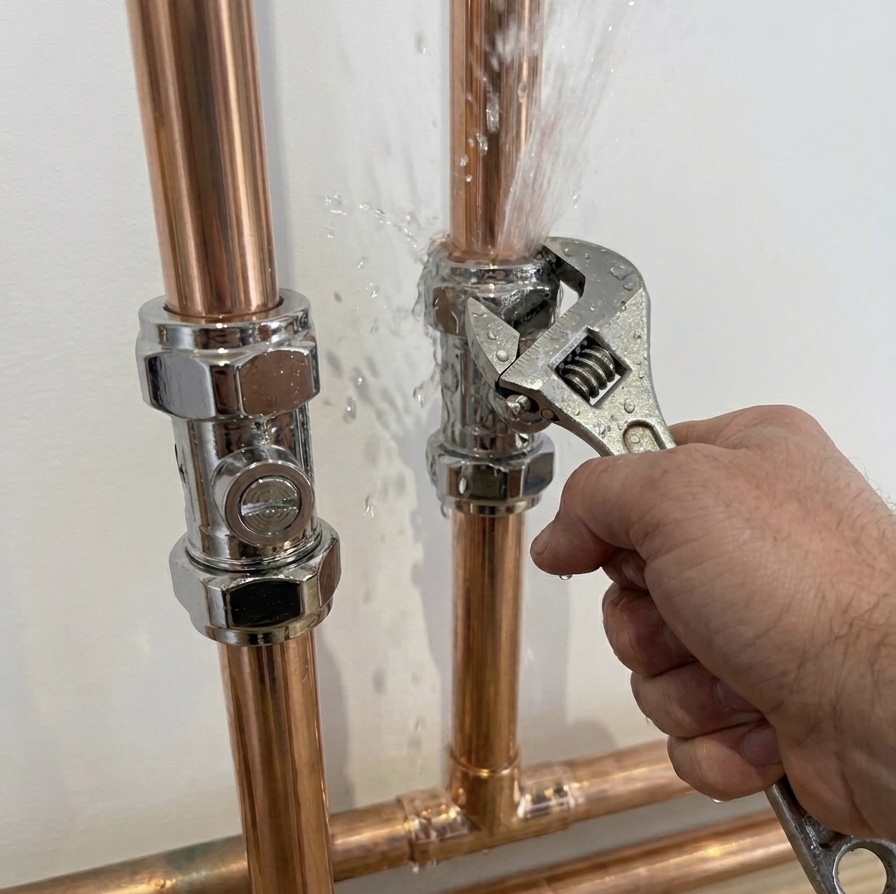
A compression fitting that weeps is one of the most common plumbing problems there is. You tighten it, it drips. You tighten it more, it still drips. Before you reach for the phone, there are three things you can try — each one escalating slightly — that will fix it nine times out of ten.
How Compression Fittings Work
Before you start fixing one, it helps to understand what's actually going on inside the fitting. A compression joint has three parts:
- The body — the brass fitting itself (a straight coupling, elbow, tee, or valve)
- The olive — a small ring, either brass or copper, that sits around the pipe inside the fitting
- The nut — the cap nut that threads onto the body and squeezes the olive
When you tighten the nut, it pushes the olive down against a tapered seat inside the body. The olive compresses onto the copper pipe, deforming slightly to create a watertight seal. That's it — no solder, no glue, no heat. The seal is entirely mechanical.
When a compression fitting leaks, it's almost always because the olive isn't making a clean seal against the pipe. Either it wasn't tightened enough, it's sitting on a mark or burr on the pipe, or the olive itself is damaged.
What you'll need
- An adjustable spanner or wrench
- A set of plumbing grips (to hold the fitting body)
- PTFE tape
- A junior hacksaw (if you need to replace the olive)
- A flat-head screwdriver
- A replacement olive — copper or brass, matching the pipe size (15mm or 22mm)
Method 1: Tighten It Up
The simplest fix. Sometimes a compression fitting just needs another quarter-turn.
Hold the body of the fitting with your grips so it can't rotate, then use your spanner on the nut. Give it a quarter-turn — not a full turn, not half a turn. A quarter. You're compressing the olive a tiny bit more onto the pipe. If the fitting was just slightly undertightened when it was originally made, this is all it needs.
Don't keep cranking
If a quarter-turn doesn't stop the leak, another quarter-turn probably won't either. Overtightening a compression fitting will deform the olive past the point where it can seal, or crack the nut, or distort the pipe. You'll make it worse, not better. If tightening didn't work, move on to method 2.
Method 2: PTFE Tape Around the Olive
This is the most common fix that actually works when tightening alone doesn't. You're wrapping PTFE tape around the olive to fill any tiny gaps between the olive and the fitting body.
How to do it
- Turn the water off (or isolate the fitting if there's a valve nearby).
- Undo the compression nut and gently separate the joint. If the pipe is fixed in place, you might need to ease it back slightly — there's usually enough flex.
- You'll see the olive sitting on the pipe. It won't slide off because it's been compressed onto the copper — that's fine, you don't need to remove it.
- Wrap PTFE tape around the olive. Go in a clockwise direction (when looking at the end of the pipe) so the tape doesn't peel off when you reassemble. Six or seven wraps is plenty.
- Tear the tape cleanly and press the end down so it's neat.
- Slide the fitting back together and tighten the nut. You'll feel it compress — firm it up, don't force it.
- Turn the water back on and check.
Why clockwise?
When you thread the nut back on, it turns clockwise. If you've wrapped the PTFE in the same direction, the tape gets pulled tighter as the nut turns. Wrap it anti-clockwise and the nut will unravel it as you tighten — you'll end up with a wad of loose tape inside the fitting doing nothing useful.
This works the majority of the time. The PTFE fills the microscopic gaps between the olive, the pipe, and the body that were causing the weep. If this has fixed it, you're done.
Method 3: Replace the Olive
If PTFE tape didn't fix it, the olive itself is probably the problem. It might be scored, misshapen from overtightening, or sitting on a burr on the pipe. The fix is to cut it off and put a new one on.
Removing the old olive
- Turn the water off and undo the fitting completely. Slide the nut back along the pipe, out of the way.
- The olive will be stuck on the pipe — it's been compressed on, so it won't slide off by hand.
- Using a junior hacksaw, make a diagonal cut across the olive. Cut into the olive, not the pipe. You only need to go about three-quarters of the way through. The olive is soft brass or copper, so it cuts easily.
- Once you've got a good line through it, wedge a flat-head screwdriver into the cut and twist. The olive will snap open and slide off.
Don't nick the pipe
This is the only thing that can go wrong here. If your hacksaw blade cuts into the copper pipe, you've created a new problem. Go slowly, support the olive with your thumb, and stop as soon as you feel the resistance change from olive to pipe. A junior hacksaw gives you more control than a full-size one. If you can't get a hacksaw in because the fitting is tight against a wall, a Dremel with a thin cutting disc works — but be even more careful with the pipe.
Fitting the new olive
- Slide a new olive onto the pipe. Copper or brass — either works. Make sure it's the right size (15mm for 15mm pipe, 22mm for 22mm).
- Slide the nut back down over the olive.
- Reassemble the fitting and tighten. You'll feel the new olive compress. It should feel firm and positive.
- Turn the water on and check.
You don't need PTFE tape on a new olive — a fresh olive on clean pipe should seal perfectly on its own. But if you want the belt-and-braces approach, a few wraps won't hurt.
Still Leaking? What Else It Could Be
If you've tried all three methods and the fitting is still weeping, the problem is almost certainly the pipe itself rather than the fitting. Common culprits:
- A scored or scratched pipe. If there's a mark or groove on the copper where the olive sits, the olive can't form a clean seal around it. You'll need to cut back to clean pipe and redo the joint.
- An oval pipe. If the pipe has been squashed or bent near the joint, it's no longer perfectly round. The olive can't compress evenly around an oval pipe. Again — cut back to a good section.
- Corroded pipe. On older pipework, the copper surface can be pitted or rough. The olive needs smooth copper to seal against. If the pipe is in that state, it probably needs replacing rather than patching.
There's also a product called plumber's mate (or LSX jointing compound) that you can smear around the olive before reassembly. It's a sealant that fills gaps. It works, but it's a cover-up rather than a proper fix — we'd only use it as a last resort on a fitting that's going to be boxed in and forgotten about.
If you've been through all of this and you're still staring at a drip, it's time to call someone in. Sometimes a fitting just needs remaking from scratch with fresh pipe, and that's easier with two hands free and a van full of parts.