How to Fit a Bath: Complete Installation Guide
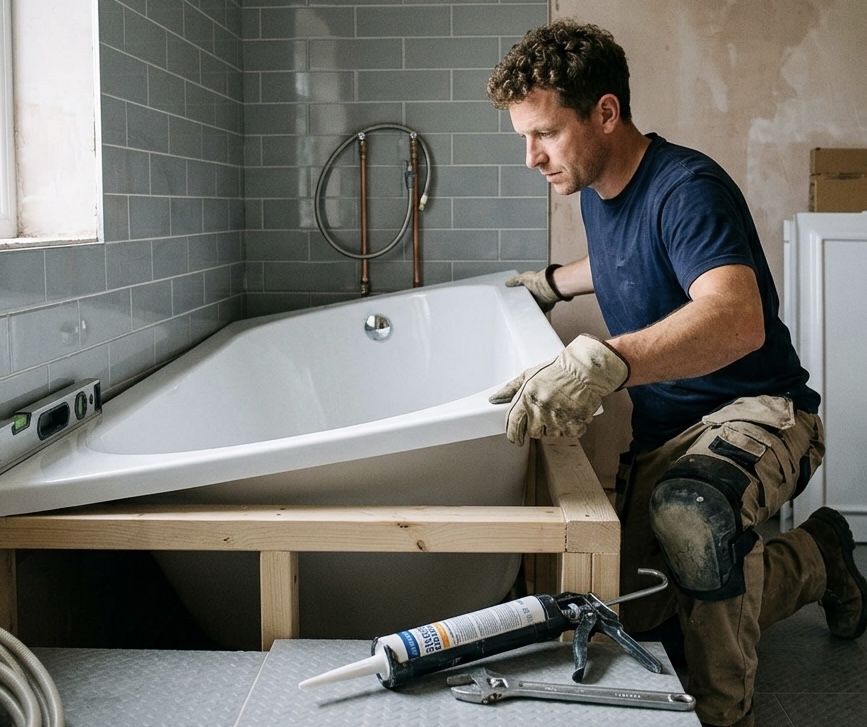
Fitting a bath properly means it won't leak, won't move, and the panel will fit perfectly. It's a logical sequence — prep the bath on its side, fit the waste and taps before it goes in, set the height using wall battens, fix it in place, connect the plumbing, and seal it. Miss a step or do them in the wrong order and you'll be taking it back out again. Here's the complete process.
Prep: Feet, Support Bars, and Cradle
Stand the bath on its end in a clear space where you can work on the underside. Most acrylic baths come with two steel support bars and four adjustable feet. Some include a centre bar and a fifth foot for longer baths.
- Screw the support bars to the underside of the bath using the screws provided. Space them evenly. If there are pre-drilled holes, use those. If not, space the bars roughly one-third of the way in from each end.
- Use the screws provided — nothing longer. The base of an acrylic bath is thin. A screw even 5mm too long will poke through into the bath and you'll have a hole that leaks and a bath that's ruined.
- Thread the adjustable feet into the bars. Leave them set high for now — you'll adjust the height later once you know where the bath is sitting.
Fit the Waste, Overflow, and Trap
Fit all the waste components now, while the bath is on its side and you can see what you're doing. Once the bath is against the wall, access to the waste is severely limited.
- Overflow first. Peel back the protective film around the overflow hole. Place the foam washer and rubber seal on the overflow body, push it through from inside the bath, and tighten the backing plate from behind.
- Waste plug next. Feed the seal up through the waste hole from underneath, seat the waste body into it from inside the bath, and tighten the screw from above. This compresses the seal against the bath.
- Connect overflow to waste. A flexible pipe with compression nuts connects the overflow outlet to the waste body. Cut it to length, fit the seals in the right order (check the instructions — each brand differs), and tighten both nuts.
- Fit the trap. The trap screws onto the bottom of the waste. This is the U-bend that holds water and blocks sewer gas. Make sure the nut is tight — this joint is under constant water pressure every time you run the bath.
Do this before the bath goes in
Fitting a waste while lying on your back under a bath that's against a wall, in a dark cupboard-sized gap, is miserable. Do it now while the bath is on its side in a well-lit space. Every plumber who's done it the other way will tell you the same thing.
Drill and Fit the Bath Taps
If your taps go on the wall, skip this section. If they mount on the bath rim (deck-mounted), do this now for the same access reason as the waste.
Marking the tap holes
- Measure the bath length and find the centre point. Mark it on the rim.
- Check the tap's hole centres — typically 180mm for a bath filler. Mark half that distance (90mm) either side of the centre line.
- Find the centre of the bath rim width (usually 50mm on a 100mm rim). Mark a cross where the two lines intersect — these are your drill points.
- Put masking tape over the area first so you can draw on it clearly and the drill doesn't wander.
Drilling
Pilot with a 3mm drill bit on each mark. Then use a 35mm or 38mm hole saw (check the tap instructions for the maximum size). Go slowly, keep the drill upright, and don't push hard — let the hole saw do the work. Acrylic cuts easily.
Fitting the taps
Drop the tap body through the holes from above. From underneath, fit the fibre washers and brass nuts. Tighten firmly — the tap should not rock or rotate. Attach the flexible tap connectors to the underside of each tap. If the tap position makes access difficult once the bath is in, fit the flexes now and leave them dangling — you'll connect them to the supply pipes later.
Set the Bath Height
The bath height is determined by the bath panel. The panel needs to fit between the underside of the bath rim and the finished floor — with a few millimetres gap at the bottom for tolerance.
- With the bath standing on its feet (set high), hold the bath panel in position. There should be a gap at the top — the panel shouldn't fit yet.
- Measure from the bottom of the panel to the underside of the bath rim. This measurement is the height your wall battens need to sit at.
Measure from the finished floor, not the subfloor
If tiles or vinyl will run under the bath panel (they should, slightly), take your measurement from the finished floor level — the top of the tile, not the concrete or ply underneath. The bath panel sits on the finished floor. Getting this wrong by even 10mm means the panel won't fit or has a visible gap.
Fix Wall Battens
The bath sits on timber battens screwed to the wall, not just on its feet. The battens support the rim, prevent the bath flexing when it's full of water and a person, and ensure a solid seal against the wall.
- Transfer your height measurement onto the wall — this is the top of the batten. Mark a level line along every wall the bath touches.
- Cut battens to length (38x63mm CLS timber is ideal). Drill through the timber, drill into the wall with an SDS drill, and fix with plugs and screws. Check level as you go.
- The battens need to be dead level and at the exact same height on every wall. The bath rim sits on top of these — if they're out, the bath will be out.
Install the Bath
- Run a generous bead of adhesive (hybrid polymer grab adhesive, not silicone) along the top of each wall batten. This bonds the bath rim to the batten permanently.
- Lift the bath into position and lower it onto the battens. Push it firmly back against the wall so the rim beds into the adhesive.
- The adjustable feet should be dangling at this point — the bath is sitting on the battens, not the feet. Now drop the feet down to the floor and lock the nuts. The feet provide secondary support — the battens are the primary support.
- Check level across the bath in both directions. Adjust feet if needed.
Run a bead of sanitary silicone around the bath rim where it meets the wall. This is your second line of defence — the adhesive on the batten is the first. The tiles or wall boards will later overlap the rim, and the final visible silicone bead (applied last) is the third layer.
Connect the Plumbing
Water supply
Connect the flexible tap connectors to the hot and cold supply pipes. If you fitted the flexes to the taps earlier, they should be dangling behind the bath ready to push onto the pipework. Tighten the compression nuts — the flexes have rubber O-rings inside, so you don't need excessive force.
Turn on the isolation valves and check for leaks at every connection before the bath panel goes on. Run water into a bucket (the waste isn't connected to the soil pipe yet) to test the taps work and the waste doesn't leak.
Waste pipe
Connect the trap outlet to the waste pipe running to the soil stack. Use solvent weld or push-fit fittings depending on your waste system. The waste pipe should fall at a minimum of 1:40 (1cm drop per 40cm run) for gravity drainage.
Seal the Bath
Sealing happens in three stages:
- Behind the bath (already done) — adhesive on the battens and silicone on the rim before tiling.
- Tile or board the wall — bring the tiles or shower boards down over the bath rim so they overlap it by 5–10mm. This means water runs down the wall face and onto the bath rim, not behind it.
- Final silicone bead — once the wall is finished, run a neat bead of sanitary silicone where the tiles meet the bath rim. Profile it with a silicone profiling tool for a clean, professional finish. This is the visible seal and the first line of defence against water.
Bath first, then tile
Always fit the bath before tiling the wall. If you tile first and then try to seal the bath against the tiles from below, water will track behind the tiles and cause damp. Tiles overlapping the bath rim is the only way to guarantee a waterproof junction.
Fit the bath panel. If you set the height correctly, it should click into the clips with a few millimetres gap at the bottom. Fix a small timber batten along the floor behind the bottom edge of the panel to stop it being pushed inward.