How to Balance Radiators: Fix Uneven Heating and Save Money
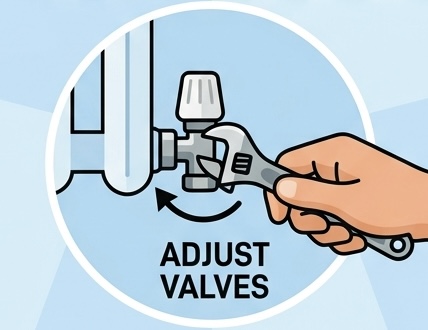
If some radiators in your house are scorching hot while others barely get warm, your system isn't balanced. Hot water takes the path of least resistance — it floods the nearest radiators and starves the furthest ones. Balancing fixes this by restricting flow to the closest radiators so more water reaches the ones further away. It's free, it takes an hour, and it can noticeably reduce your gas bills.
Why Radiators Need Balancing
Your boiler heats water and the pump pushes it around a circuit of pipes. The hot water flows through each radiator, gives up some heat, and returns to the boiler cooler. The problem is that water, like anything, takes the easiest route. The first radiator on the circuit gets the hottest water at the highest flow rate. The last radiator on the circuit gets whatever's left.
In a two-storey house, this is even more pronounced. Hot water naturally rises, so upstairs radiators often get more heat than downstairs ones. You end up with bedrooms at 24°C while the living room sits at 17°C — the boiler is working hard but the heat isn't going where you need it.
What balancing actually does
Balancing doesn't change how much heat the boiler produces. It changes how that heat is distributed. By partially closing the lock shield valves on the radiators closest to the boiler, you force more water to travel further to the radiators at the end of the circuit. Every radiator gets a fair share of hot water, every room reaches a comfortable temperature, and the boiler doesn't have to work overtime to compensate for uneven distribution.
What Is a Lock Shield Valve?
Every radiator has two valves. One end has the TRV (the one with the numbered dial) or a manual wheel valve. The other end has the lock shield valve — covered by a plain plastic cap with no markings.
The lock shield controls the flow rate through the radiator on the return side. It's called "lock shield" because once it's set, you put the cap back on and leave it alone — it's locked in position. Most homeowners never touch it, which is why most heating systems are unbalanced.
To access it, pull or unscrew the plastic cap. Underneath is a spindle with a flat or square head. You adjust it with an adjustable spanner or small grips — clockwise to close (restrict flow), anti-clockwise to open (increase flow).
Preparation
- Turn the heating on and let the system run for 30 minutes until all radiators are warm.
- Work out the order. Walk around the house and note which radiators heated up first, second, third, and so on. The one that got hot first is closest to the boiler on the circuit. The one that heated up last is furthest away. Write the order down — you'll need it.
- Remove all lock shield caps. Go around every radiator and pop the caps off so you can access the spindles easily.
Now choose your method. Method 1 is more precise and gives better results. Method 2 works if you don't have a thermometer.
Method 1: With a Thermometer (Precise)
For this you need a way to measure the pipe temperature at each radiator. A digital thermometer with a pipe clamp probe is ideal. A thermal imaging camera plugged into your phone also works. Even a cheap infrared thermometer gun (under £15 online) is accurate enough.
What you're aiming for
On each radiator, you want a temperature drop of about 12°C between the flow pipe (water going in) and the return pipe (water coming out). For example, if water enters the radiator at 65°C, you want it leaving at about 53°C. This tells you the radiator is extracting the right amount of heat from the water before it returns to the boiler.
Step by step
- Start at the first radiator (closest to the boiler). Measure the temperature on the flow pipe going into the radiator. Then measure the return pipe coming out through the lock shield valve.
- If the temperature drop is less than 12°C (say, only 5°C), the water is flowing through too fast — it's not spending enough time in the radiator to give up its heat. Close the lock shield a quarter-turn clockwise.
- Wait five minutes for the temperatures to stabilise, then measure again.
- Keep adjusting in quarter-turns until you get close to a 12°C drop.
- Move to the next radiator in the sequence and repeat.
- The last radiator on the circuit should have its lock shield fully open — it needs all the flow it can get because it's furthest from the boiler.
Which pipe is flow and which is return?
Don't assume the TRV is always on the flow side. On modern installations, either valve can be on either pipe. The easiest way to tell: when the heating first comes on, feel both pipes at the bottom of the radiator. The one that gets hot first is the flow. On a thermal camera, the flow pipe will be 10–15°C hotter than the return.
Method 2: Without a Thermometer (Practical)
If you don't have any temperature reading equipment, you can still balance the system using the graduated restriction method. It's less precise but gets you most of the way there.
- Close all lock shield valves fully. Go to every radiator in the house and turn every lock shield clockwise until it stops. All flow through the lock shields is now stopped.
- First radiator (closest to boiler): open the lock shield a quarter-turn anti-clockwise. Just a quarter — this is the most restricted radiator because it's getting first dibs on the hot water.
- Last radiator (furthest from boiler): open the lock shield fully — turn it all the way anti-clockwise until it stops.
- Every radiator in between: open each one a little more than the previous one. If the first is a quarter-turn, the second might be a third of a turn, the third half a turn, the fourth three-quarters, and so on — gradually increasing until the last one is fully open.
The principle is simple: the closer a radiator is to the boiler, the more you restrict its lock shield. The further away, the more you open it. This forces the system to distribute water more evenly.
Give it 24 hours
After balancing, let the system run through a full day/night heating cycle before making further adjustments. It takes time for the whole system to find its new equilibrium. If after 24 hours a particular room is still too cold or too hot, adjust that radiator's lock shield by an eighth of a turn and wait another day. Small adjustments, patiently applied.
After Balancing
- Put the lock shield caps back on. This prevents anyone accidentally knocking the setting. The whole point of the "lock" in lock shield is that once set, it stays set.
- Don't touch the lock shields again unless you add or remove a radiator from the system, which changes the circuit and requires re-balancing.
- Use TRVs for room-by-room temperature control. The lock shields set the base flow balance. The TRVs then fine-tune each room's temperature on top of that. They're designed to work together — balanced lock shields with TRVs on top is how the system is meant to operate.
- Check your boiler isn't short-cycling. After balancing, if the boiler is firing for only a few minutes then shutting off, the flow rate may be too low. Open the lock shields on the closest radiators slightly more to increase the overall flow. Short-cycling wastes gas and wears the boiler.
How much can you actually save?
A properly balanced system means the boiler runs for shorter periods because heat reaches every room efficiently. The Energy Saving Trust estimates that balancing radiators combined with proper TRV use can save £50–75 per year on a typical gas bill. That's for a job that costs nothing but an hour of your time.