How Thermostatic Radiator Valves (TRVs) Actually Work
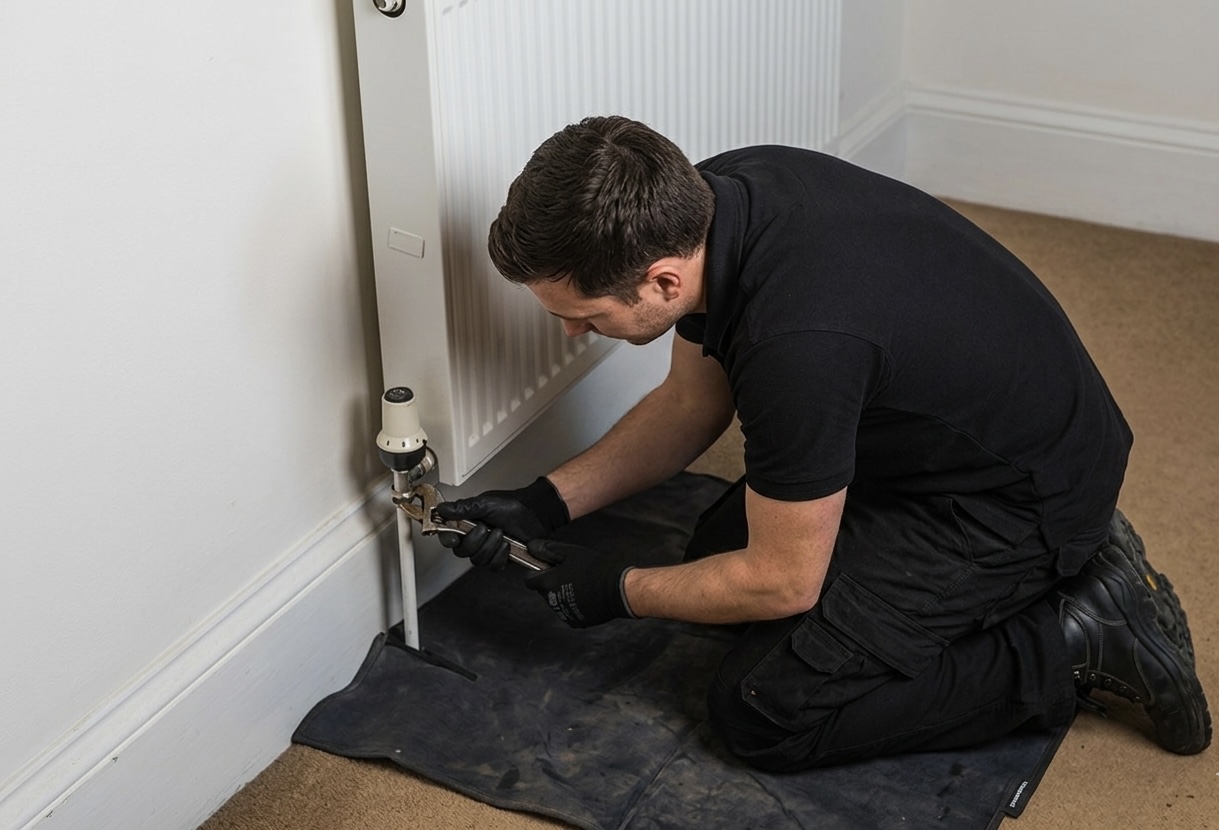
Almost every radiator in the UK has a thermostatic radiator valve on it. Almost nobody uses them correctly. Most people treat the numbered dial like a volume knob — cold room, crank it to 5. But that's not what the numbers mean, and doing that defeats the entire purpose of having one. Here's how TRVs actually work and how to use them to keep your rooms comfortable while saving energy.
What a TRV Actually Does
A TRV senses the temperature of the room, not the temperature of the radiator. This is the single most important thing to understand. The TRV head has small vents or slots in the casing. Air passes through these vents and warms a sensor element inside — either a wax capsule or a liquid-filled bellows.
As the room warms up, the sensor element expands. This expansion pushes a pin down into the valve body, which gradually closes the valve and reduces the flow of hot water into the radiator. As the room cools, the sensor contracts, the pin rises, the valve opens, and hot water flows again.
It's a self-regulating thermostat for each individual room. The boiler sends hot water to every radiator, but the TRV controls how much actually gets in based on the room temperature around it. No electronics, no batteries, no programming — it's entirely mechanical.
The key fact
The TRV doesn't control how hot the radiator gets. It controls how hot the room gets. The radiator is just the tool it uses to achieve that. Once the room reaches the temperature you've set on the dial, the TRV closes the valve and the radiator cools down — because the room doesn't need any more heat.
What the Numbers Mean
The numbers on a TRV correspond to approximate room temperatures. They're not arbitrary — each number represents a target temperature that the TRV will try to maintain in the room.
Typical TRV number guide
- ❄ (frost/snowflake) — approximately 7°C. Frost protection only. The radiator will only come on if the room drops near freezing. Use this for unoccupied rooms or when away in winter.
- 1 — approximately 10–12°C. Very cool. Suitable for rarely used rooms.
- 2 — approximately 15–16°C. Cool. Hallways, utility rooms.
- 3 — approximately 18–20°C. The comfortable range for most living spaces. This is where most TRVs should live.
- 4 — approximately 22–24°C. Warm. Bathrooms, living rooms where you want it toasty.
- 5 — approximately 26–28°C. The valve is essentially fully open. The TRV will rarely shut off at this setting because most UK rooms never reach this temperature.
The exact temperatures vary slightly between manufacturers, but the principle is the same across all TRVs. Most come with a leaflet showing the specific temperature each number corresponds to — it's worth checking if you still have it.
The Mistake Almost Everyone Makes
You walk into a cold room. The radiator is hot. You turn the TRV from 3 to 5. What have you actually done?
Nothing useful. The radiator was already on — the TRV had already detected that the room was cold and opened the valve fully. Hot water was already flowing. The radiator was doing its job. By turning the dial to 5, you've told the TRV to let the room get to 28°C before it starts throttling back. In a typical UK house, the room will never reach 28°C, which means the TRV will never close, which means you've effectively disabled it. The radiator runs flat out all the time, burning gas for heat you don't need.
The other common scenario: you walk into a cold room, the radiator is also cold, so you crank the TRV to 5. But the reason the radiator was cold might have been that the boiler hadn't fired yet, or the room was at the target temperature an hour ago before you opened a window. Jumping to 5 doesn't make the room heat up faster — the boiler sends water at the same temperature regardless of what the TRV is set to. All you've done is raised the target temperature far beyond what you actually want.
Turning a TRV to 5 does NOT make the room heat faster
This is the single biggest misconception. The TRV is either open or closed (or somewhere in between). When the room is cold and the TRV is set to 3, the valve is already fully open — maximum flow. Setting it to 5 doesn't increase the flow beyond fully open. The room heats at the same rate. The only difference is that at 5, the TRV won't close until the room hits 28°C, which wastes energy.
How to Use a TRV Properly
The correct approach is the opposite of what most people do. Instead of reacting to how the room feels right now, you set the TRV to the temperature you want the room to be, and then leave it alone.
Setting up your TRVs
- Start at 3 on all radiators in rooms you use regularly. This targets roughly 18–20°C — the recommended comfortable room temperature.
- Give it 24 hours. Let the system run for a full day. The TRVs need time to find their rhythm with the boiler cycle and the room's heat loss characteristics.
- Adjust by one number at a time. If a room feels cold after 24 hours on setting 3, turn it up to 3.5 or 4. If it feels too warm, turn it down to 2.5. Small adjustments. Not 1 to 5 and back again.
- Set different rooms to different temperatures. That's the whole point of TRVs — individual room control. Bedrooms might suit 2 (cooler for sleeping). The living room might need 3 or 4. The hallway can sit at 2. Spare rooms on frost protection.
The golden rule
If you walk into a room and the radiator is hot but the room is cold, the TRV is doing its job — it's trying to heat the room. Leave it. If you walk into a room and the radiator is cold and the room is cold, the TRV might be set too low, or it might be stuck (see problems below). Turn it up by one notch and wait. Don't jump to 5.
Energy saving
Properly used TRVs save a significant amount of energy. The Energy Saving Trust estimates that TRVs used correctly can save up to £75 per year on gas bills for a typical semi-detached house. That's without changing your boiler, without insulation upgrades, without smart thermostats. Just using the little numbered dials properly.
The saving comes from rooms not being heated beyond what's needed. Without TRVs (or with TRVs all set to 5), every radiator runs flat out whenever the boiler fires. With TRVs set correctly, rooms that reach temperature first shut their radiators down, reducing the total heat demand on the boiler.
Common TRV Problems
Stuck pin
The most common TRV fault. The pin that moves up and down inside the valve body can seize in the closed position, especially after summer when the heating hasn't run for months. The TRV head reads the room as cold but the pin is physically jammed shut, so no water flows and the radiator stays cold. See our radiator not working guide for how to free a stuck TRV pin.
TRV blocked by curtains or furniture
If a curtain hangs over the radiator or a sofa is pushed against it, the TRV head sits in a pocket of warm air from the radiator itself. It thinks the room is warm and closes the valve, even though the rest of the room is cold. The fix is simple: make sure there's airflow around the TRV head so it senses the actual room temperature, not radiated heat from the radiator.
TRV on the wrong radiator
You shouldn't fit a TRV on the radiator in the same room as the main room thermostat. If both try to control the boiler and the room temperature independently, they can fight each other — the TRV shuts the radiator, the room thermostat reads cold and keeps calling for heat, the boiler runs but achieves nothing. The radiator in the thermostat room should have a manual valve (lockshield at both ends) instead of a TRV.
Worn out TRV head
TRV heads lose accuracy over time as the wax capsule or bellows degrades. If a TRV that used to work fine now doesn't seem to respond to temperature changes, the head may need replacing. You don't need to replace the whole valve body — just the head. Most TRV heads are interchangeable within the same manufacturer, and universal heads are available that fit most valve bodies.