Bath to Shower Conversion: The Complete Process
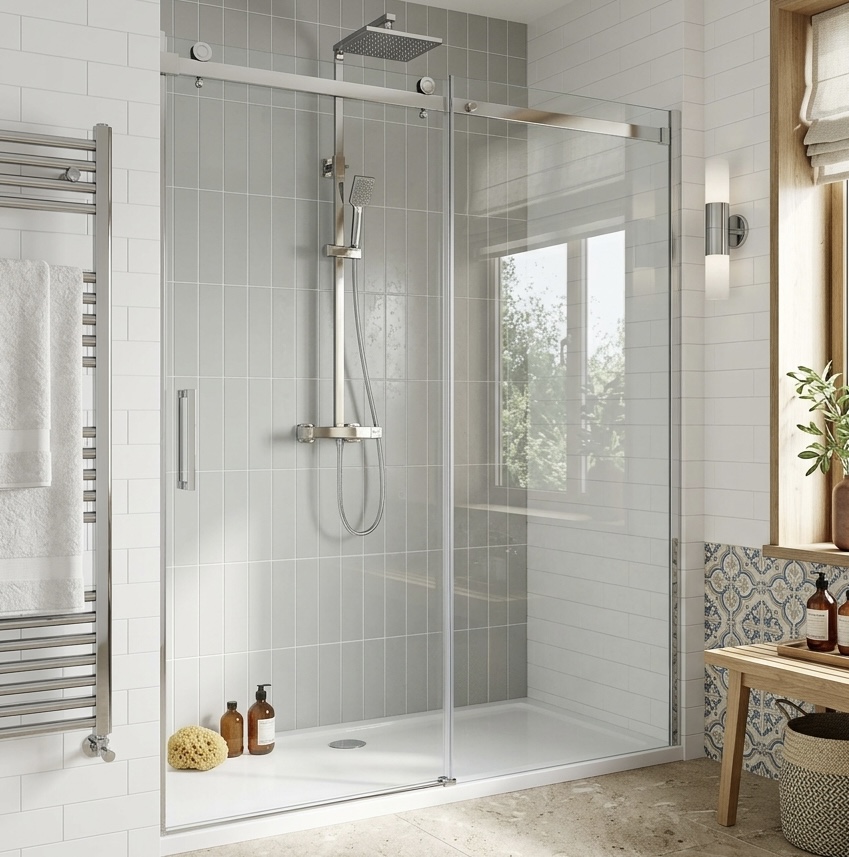
Replacing a bath with a walk-in shower is one of the most common bathroom jobs going — and one of the most worthwhile. It opens up floor space in tight bathrooms, makes the room safer and more accessible, and in most cases looks better than the ageing bath it replaces. It’s a multi-day job that touches plumbing, carpentry, levelling, and finishing, but the process is logical and each stage builds on the last.
Planning the Layout
Before you touch a tool, sketch the bathroom from above and plan where everything will go. The key questions:
- Where does the shower tray fit? It goes in the bath footprint, but you need to account for the toilet, vanity unit, and door swing. In tight bathrooms, a shower tray that’s shorter than the old bath may be the answer — you gain floor space where the bath used to extend.
- Where does the shower valve go? Not necessarily where the old bath taps were. Moving the valve to the opposite end of the tray can make the entry point more practical — especially if the toilet is in the way of the approach.
- Where does the shower screen sit? The screen needs to be on the open side of the tray where you walk in. Plan the entry route so someone can step in comfortably without squeezing past the toilet or vanity.
- Where does the waste pipe run? The existing bath waste pipe is a good starting point, but a shower tray trap sits in a different position. Check that the waste can reach the soil pipe or gully with adequate fall.
Accessibility matters
Bath-to-shower conversions are often done for mobility reasons — making the bathroom safer for someone who finds it difficult to climb in and out of a bath. If that’s the case, choose a low-profile shower tray (40–50mm high rather than 90mm+), position the shower valve where it can be reached without stepping into the water stream, and consider grab rails either now or later. Planning for accessibility at the conversion stage costs nothing. Retrofitting it later means ripping walls apart.
Stripping Out the Bath
- Isolate the water. Find the isolation valves for the bath taps and turn them off. If there are no isolation valves (common in older properties), you’ll need to turn off at the stopcock or mains. Test by opening the bath taps — if water stops, the isolation is working.
- Disconnect the taps and waste. Remove the bath tap from above or disconnect the flexible connectors underneath. Undo the waste trap from the bath waste outlet.
- Cap off the pipework. If you’re moving the shower valve to a new position, the old hot and cold feed pipes need capping. Press fittings or push-fit stop ends are the quickest option, especially in a tight space where you don’t want to use a blowtorch near combustible materials.
- Remove the bath panel and side fixings. Unscrew any brackets, remove the bath panel, and cut through any mastic sealing the bath to the wall.
- Lift out the bath. In a tight bathroom, this may mean cutting the bath into sections with a reciprocating saw. Acrylic baths cut easily. Steel baths are harder but still manageable with a metal-cutting blade. It’s often the only practical option when the bathroom door is too narrow to get a whole bath through.
Once the bath is out, you’ll see the floor and wall surfaces underneath. Expect unfinished plaster, bare timber, old adhesive residue, and an uneven floor. This is all normal and gets dealt with in the next stages.
Levelling the Floor
The floor under a bath is almost never level. Old cottages and period properties are especially bad — floors that have settled over decades, high spots from old mortar, and low corners that are centimetres out from one end to the other. A shower tray needs a flat, level base or it won’t drain properly and will crack under load.
Find the high point
- Place a long spirit level across the floor in multiple directions.
- Identify the single highest point — this is your reference. Everything else gets built up to match this height.
- Check all four corners and the midpoints between them.
Pack and level
- Get a pack of mixed-thickness plastic packers (1mm, 2mm, 3mm, etc.). Stack packers at each low point until a spirit level placed between that point and the high point reads perfectly level.
- Stick each packer stack down with a blob of adhesive so they don’t move during the pour.
- Work around all corners and midpoints until every packer stack is level with the high point.
Self-levelling compound
- Dam the edges. Use batten strips or foam tape to create a border so the compound doesn’t flow out of the shower tray area. Leave the waste pipe channel open if you still need access.
- Prime the floor. Brush on a coat of SBR primer or the manufacturer’s recommended primer. This gives the compound something to bond to.
- Mix and pour. Follow the manufacturer’s water ratio exactly — too much water and it won’t set properly, too little and it won’t flow. Pour into the low areas and let it find its own level. The compound should just touch the tops of your packer stacks.
- Let it cure. Most self-levelling compounds can be walked on within a few hours and are ready for a tray within 24 hours. Check the datasheet.
Don’t skip the levelling
A shower tray installed on an uneven floor will rock, crack, and eventually leak. The tray may look fine at first, but body weight concentrated on an unsupported area will fatigue the material over time. The levelling stage is the difference between a conversion that lasts 20 years and one that fails in 2.
Positioning the Waste Pipe
With the floor levelled (leaving the waste channel open), you can now set the waste pipe and trap at the exact position and height the shower tray needs.
- Place the shower tray dry (no adhesive) on the levelled floor. Mark the centre of the waste outlet on the floor by looking straight down through the hole and drawing around it.
- Measure the trap height. The trap needs to sit at a specific height so that when the tray goes down, the trap connects to the waste outlet cleanly. Measure from the floor to the underside of the tray waste hole and set the top of the trap at that height.
- Connect to the existing waste run. The old bath waste pipe may already be in roughly the right place. Extend or redirect it to meet the new trap position using solvent weld fittings for a permanent connection.
- Check the fall. The waste pipe needs a minimum fall of about 1:40 (25mm per metre) to drain properly. If the existing soil pipe or gully is at a similar height to the tray, you may need to raise the tray slightly or route the waste pipe differently to achieve adequate fall.
Once the trap is set at the correct height and glued in, let it cure fully before placing the tray.
Installing the Shower Tray
With the floor level and the waste pipe set, the tray goes down permanently.
- Apply adhesive to the levelled floor. Adhesive foam (expanding foam designed for bonding, not standard cavity foam) works well here. Run beads across the entire floor area, avoiding the waste pipe channel. Let it go slightly tacky (about 5 minutes) before placing the tray.
- Lower the tray into position. Guide the waste outlet onto the trap as you lower it. This is a two-person job on larger trays — the tray needs to go down straight without sliding sideways.
- Check it’s level. Place a spirit level across the tray in both directions. The tray should read level or have a very slight fall towards the drain — never away from it.
- Screw down the adjustable feet or fixing points if your tray has them. Nip them up evenly — do not overtighten. The plastic feet and brackets crack easily under excessive force, and a cracked bracket means an unsupported corner.
Shower tray types
Stone resin trays are heavier but more rigid and feel more solid underfoot. Acrylic trays are lighter and cheaper but flex more and need good support across the entire base. For a bath-to-shower conversion where the floor has been levelled with compound, either works. The key is full contact — no voids under the tray where it can flex and crack.
Wall Boards
The walls around the shower need to be waterproof. You have two main options: tiles on cement board, or shower wall boards (also called bathroom panels). Wall boards are significantly faster to install and don’t require grouting, which makes them the preferred option for most bath-to-shower conversions.
- Prepare the walls. If the old bath was tiled, remove the tiles or bond-coat over them to create a flat surface. PVA any bare plaster to seal it.
- Measure and cut each panel. Cut out holes for the shower valve, any pipe penetrations, and the shower riser fixings. A jigsaw or multi-tool makes clean cuts.
- Apply adhesive foam to the wall. Run beads in a grid pattern, let it go tacky for 5 minutes, then press the panel into place.
- Brace the panel while the adhesive sets. Use props, clamps, or temporary battens to hold the panel flat against the wall for 30 minutes until the adhesive grips. The foam expands slightly as it cures, so the panel needs to be held firm.
- Repeat for all three walls of the shower enclosure.
Wall boards go up in a morning. Tiles take days when you factor in adhesive cure time, grouting, and grout drying. For a straightforward conversion where the priority is getting the bathroom back in use quickly, boards are the practical choice. For a full guide on the process, see our post on installing shower wall boards.
Shower Valve and Riser
If you’re reusing the existing hot and cold feeds from the bath taps, you’ll need to run new pipework from the capped-off pipes to the position of the new shower valve. If you’re putting the valve on the same wall as the old taps, the pipe runs will be short.
- Box out behind the valve position. The shower valve needs timber backing behind the wall board to fix into. A piece of 18mm plywood fixed between the studs or bonded to the wall gives a solid, flat surface for the valve plate.
- Run the hot and cold pipes to the valve position. Use copper or barrier pipe, depending on what’s already in the system.
- Cut through the wall board where the valve and riser will sit. The holes should be neat — they’ll be visible around the valve escutcheon.
- Seal around the pipe penetrations with silicone on the back of the wall board before fitting the valve. Water must not get behind the panels.
- Fit the valve, shower riser, and head. Use a laser level or spirit level to get the riser rail perfectly vertical.
Bar mixer vs concealed valve
A bar mixer shower (the valve is visible on the wall surface) is simpler to fit — the pipes connect behind the wall and the valve sits on the face. A concealed valve (recessed into the wall) looks cleaner but needs more space behind the wall board for the valve body. In a tight bathroom with thin walls, a bar mixer is usually the more practical option.
Shower Screen
- Mark a plumb line where the screen will sit on the tray. Use a laser level or spirit level — the screen must be perfectly vertical or the glass will swing open or closed on its own.
- Fix the wall channel. This is the aluminium U-channel that the screen sits in. Run a bead of clear silicone down the back of the channel, press it to the wall on your plumb line, and fix through with screws. If you’ve used wall boards backed with timber, the screws bite straight in.
- Slide the glass panel into the channel. Drop the rubber seal strip into the channel first, then slide the glass in from the top.
- Fit the support bar. This runs from the top of the screen to the opposite wall and stops the glass from flexing. Cut to length, fit the wall plate, and tighten the clamp on the screen.
- Seal the base of the screen with a rubber tray seal strip. Don’t stretch it as you fit it — it will retract when you cut it and leave a gap.
Some conversions don’t need a full shower door — a fixed panel screen with an open entry is simpler, cheaper, and easier to get in and out of. For accessibility conversions, an open-entry screen with no door to wrestle with is often the better choice.
Siliconing and Finishing
Silicone is the last line of waterproofing. Every joint between the tray and walls, between wall panels, around the shower valve plate, and along the shower screen channel needs a clean bead of sanitary silicone.
- Use clear silicone on the shower screen — it’s less visible against glass.
- Use white (or colour-matched) silicone on the tray-to-wall joints and panel-to-panel joints.
- Work in sections. Apply, smooth, and clean up one run at a time. Silicone skins over quickly — if you try to do all four joints at once, the first one will have skinned before you get back to smooth it.
- Leave the protective film on the shower tray until all siliconing is complete. Peel it back just enough to expose the joint area. This protects the tray surface from silicone smears, tool scratches, and foot traffic during the final stages.
For a detailed guide on silicone technique, see our post on applying silicone sealant.
Once the silicone has cured (24 hours for a full cure), connect the water supply, test the shower valve, and check every joint for leaks. Run the shower at full flow for several minutes and check underneath the tray, around the screen base, and at every wall panel joint.
Test before you leave
Run the shower for a solid five minutes with the drain plugged (or with someone watching the trap). Water pools on the tray surface and tests every seal under real conditions. A joint that looks fine dry can weep under a standing head of water. Find it now, not when it’s soaked through the ceiling below.